

 0
0 0
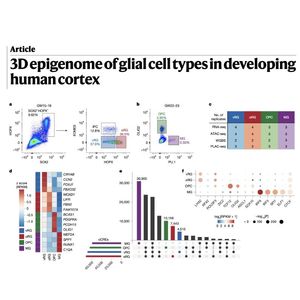
0This study presents a detailed three-dimensional epigenomic analysis of the developing human cortex, focusing on four essential glial cell types: vRG, oRG, OPC, and microglia. By integrating data on gene expression, chromatin accessibility, and DNA methylation, the researchers identified thousands of cell-type-specific regulatory elements that drive brain development. They utilized machine learning to prioritize genetic variants associated with schizophrenia and Alzheimer’s disease, successfully validating how specific risk alleles disrupt enhancer activity in vivo. Furthermore, the findings reveal that outer radial glia (oRG) are enriched with human accelerated regions (HARs), suggesting these elements played a pivotal role in the evolutionary expansion of the human brain. Ultimately, this research provides a high-resolution map of the gene regulatory programs that underlie human corticogenesis and neuropsychiatric vulnerability.
References:
Jones I R, Wang L, Kosicki M, et al. 3D epigenome of glial cell types in developing human cortex[J]. Nature, 2026: 1-10.
