

 1
1 0
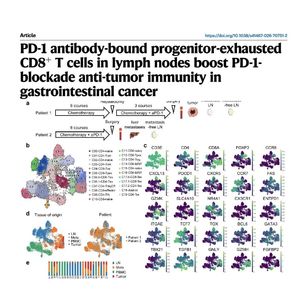
0This research study examines how immune checkpoint inhibitors (ICIs) enhance anti-tumor responses in gastrointestinal cancer patients. By employing advanced single-cell sequencing and a novel anti-IgG4 detection method, researchers tracked the behavior of progenitor-exhausted T cells (Tpex) across tumors, blood, and lymph nodes. The findings reveal that lymph nodes act as critical reservoirs where therapeutic antibodies bind to Tpex, triggering their proliferation and clonal expansion. These activated cells subsequently migrate to the tumor microenvironment, where they differentiate into exhausted T cells (Tex) to combat the cancer. The study highlights that a high ratio of Tpex in metastasis-free lymph nodes correlates with a better prognosis, offering vital insights into the systemic cellular mechanisms of immunotherapy.
References:
Nose Y, Yasumizu Y, Saito T, et al. PD-1 antibody-bound progenitor-exhausted CD8+ T cells in lymph nodes boost PD-1-blockade anti-tumor immunity in gastrointestinal cancer[J]. Nature Communications, 2026.
