

 1
1 0
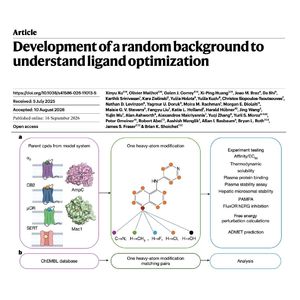
0Ligand optimization remains a fundamental yet inefficient step in early drug discovery, largely due to a lack of baseline expectations for random modifications. To establish this missing background, researchers systematically tested 257 single-atom analogues derived from 18 parent molecules across six biological targets, intentionally avoiding design biases. The experiments revealed that 11.3% of these minor structural tweaks unexpectedly improved target potency by tenfold or more, with methyl and chlorine substitutions yielding the highest success rates. However, these potency gains typically coincided with a frustrated landscape, where improved binding traded off against worsening pharmacokinetic properties such as permeability and metabolic stability. Furthermore, while computational tools like free-energy calculations and artificial intelligence showed promise in predicting these trends, their correlations remained insufficient to replace physical experimentation entirely. Ultimately, despite these pharmacokinetic trade-offs, careful multi-parameter navigation successfully produced enhanced in vivo analgesics, demonstrating that systematic positional scanning provides a valuable strategy for charting chemical space.
References:
Xu X, Mailhot O, Correy G J, et al. Development of a random background to understand ligand optimization[J]. Nature, 2026: 1-9.
