
COY WIRE, CNN 10 ANCHOR: Hello, lovely people. I'm Coy Wire. Welcome to CNN 10. It's Wednesday, December 4th.
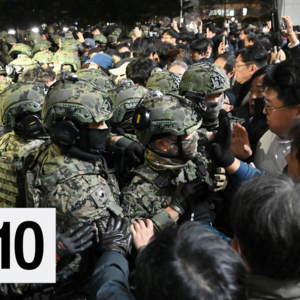
We start in South Korea, where President Yoon Suk Yeol declared martial law in a surprise TV address on Tuesday. In short, martial law is a temporary rule by military authorities in a time of emergency.
Yeol is accusing the country's main opposition party of sympathizing with North Korea by taking actions he says are aimed at inciting a rebellion.
Following the announcement, protests were seen outside the parliament, and South Korea's parliament had voted to block martial law. This is a developing story, and we'll have more on this in tomorrow's show.
Next, today concerns are being raised over facial recognition, technology being powered by artificial intelligence used to identify a person from an image or video. Now it's technology that's been around for quite some time, and it's part of some of our daily lives. We might use it to unlock our phones, access our virtual wallets, maybe even prove our identity to get in a shorter line at the airport.
CNN's Sara Sidner sat down with the CEO of CLEAR, the company that uses facial recognition and other biometric data like fingerprints to fast track your experience at the airport.
Here's why she thinks facial recognition should be part of everyone's everyday life.
SARA SIDNER, CNN SENIOR CORRESPONDENT (voice-over): Caryn Seidman-Becker is the CEO of CLEAR, you know, the company with the kiosks at the airport that allows you to skip the other lines for a fee.
(On camera): So, your company is really sort of a disruptor type of company. It's there. It's different. You go. You get your eye scanned. You get your finger scanned. But once it got really popular, then we, as customers, started getting frustrated because the lines started getting long. What are you doing about that?
CARYN SEIDMAN-BECKER, CLEAR CEO: I always say, we're obsessed with the member experience. We look at data all day long. We can see tons of trends.
This has been a period of improved member experience over 2024. We expect to see that accelerate over the next 12 months as we roll out our Face First technology, which is really awesome. It's in about 12 airports today. It's been two weeks, and it is, you know, five times as fast. I think the coolest thing that we're working on is really the concept of the secure identity network.
SIDNER: How could this end up making life easier, not just at the airport?
SEIDMAN-BECKER: Not only can it make life easier, it is making life easier. So, we want to go from using it multiple times a year in airports, to multiple times a day.
Today, let's just say you live in L.A. You could use it getting into an Uber for rider verification within the rider app. And then let's say you're going to the Intuit Dome to watch a Clippers game with just your face and CLEAR, right, because you are your age and your payment.
You could check in at a doctor's office with your face. You're there for your appointment. What I see as the ultimate check in at the doctor's office is, your face is your appointment, it's your insurance card that's verified and validated, and then it is also your copay and your credit card.
WIRE: Throughout this week, Call to Earth is turning the spotlight on French Polynesia and an organization working to restore coral reef ecosystems around the world.
Titouan Bernicot started Coral Gardeners in 2017, cogitating over healthier oceans when he was just 18 years old as part of the Rolex Perpetual Planet Initiative. They are on a to plant one million corals worldwide by the end of 2025, a strategy they've dubbed Odyssey 2025.
ZAIN ASHER, CNN INTERNATIONAL ANCHOR (voice-over): This is Tahiti, one of three permanent ocean-based coral nurseries in Mo'orea. As Coral Gardeners, both by company name and by profession, these sites are at the core of what they do on a daily basis.
TITOUAN BERNICOT, FOUNDER & CEO, CORAL GARDENERS: Coral gardening is the coolest thing on Earth. You are underwater. There is nobody talking. You hear the sound of the parrotfish, like the noise of the waves. You have those thousands of little coral fragments, and you have the fish. They become your co-workers. It's something so tangible. It's such a rewarding feeling to see your tiny coral fragment growing.
ASHER: First on the day's to-do list is installing new underwater foundations, a task assigned to Gardeners Loic and Yohan (ph).
BERNICOT: I think that's -- that's the most physical part.
ASHER: Right now is also out planting season, meaning there are healthy and heat-resilient coral ready to be relocated back onto the damaged reef. To preserve the health of the colony, they'll take no more than 10%.
BERNICOT: Taino (ph) and I will create a coral rope. That's the process of coral gardening. We have the tag, nursery number two, rope number one.
That's how we do all the scientific monitoring behind.
📰字数限制, 完整文本见公众号【琐简】,回复"1"可进【打卡交流群】
CNN 10|Martial law, facial recognition, coral planting
6分钟 · 160·
160· 0
0
1600