
COY WIRE, CNN 10 ANCHOR: All right, we start today with news out of North America where the leaders of the U.S., Mexico, and Canada announced a deal to pause U.S. President Donald Trump's tariffs on imports from two of America's closest trading partners for at least 30 days.
On Monday, President Trump signed two new executive orders that put a pause to a planned 25% tariff on Canada and Mexico that were set to take effect on Tuesday. There were also 10% tariffs levied against China over the weekend, but those still went into effect on Tuesday.
Tariffs are essentially taxes on imported goods and part of the Trump administration's goal in levying the tariffs on Mexico and Canada was to convince those countries to do more to stop the flow of drugs and undocumented immigrants from coming into the U.S. And it seems both Mexico and Canada are setting out to conciliate President Trump.
Both U.S. neighbors stood down on retaliatory tariffs of their own while agreeing to boost border security and increase efforts to combat drug trafficking. In Mexico, President Claudia Sheinbaum committed to deploying 10,000 of Mexico's National Guard members to the U.S.-Mexico border. And in Canada, Prime Minister Justin Trudeau said that in exchange for the tariff pause, the country will invest in border security, create a joint strike force with the U.S. to combat organized crime, appoint a fentanyl czar, and join the U.S. enlisting cartels as terrorist groups.
The fallout from the tariff threat was swift. U.S. stock markets were shaky on Monday. Businesses braced for tough periods of higher prices. With the tariffs now paused for the U.S. and its neighbors, all three of the nation's economies could be avoiding the worst impacts like boosted inflation, a recession, and an expanding trade war.
Over the weekend, the Palisades and Eaton fires in Southern California were fully contained nearly a month after the blazes broke out. The two fires are the second and third most destructive wildfires in California history, according to Cal Fire. Over 37,000 acres were burned, with homes and businesses destroyed and dozens of people losing their lives.
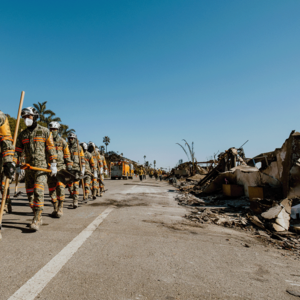
Now officials are focusing on the cleanup, what will be a months-long process to remove toxic ash, hazardous waste, and charred debris from everyday items is already underway. CNN's Julia Vargas Jones is on the ground in a burn zone in Altadena to show us how teams from the Environmental Protection Agency are working to clear the hazardous waste the fires have left behind.
JULIA VARGAS JONES, CNN CORRESPONDENT (voice-over): Sifting through Altadena's ashes, what were once homes now piles of toxic waste. The cleanup after the deadly Eaton Fire is just beginning.
HARRY ALLEN, ON-SCENE COORDINATOR, EPA: So we put a white x to mark that we've checked it, and it doesn't have anything dangerous in it.
JONES: Weeks after flames decimated thousands of homes and businesses, crews in hazmat suits roam the ruins, the Environmental Protection Agency carrying out what they call phase one, a painstaking process, removing all that is hazardous in the fire's aftermath.
ALLEN: They're common goods from your house, paints from your shop. They may be oils from your garage, propane from your grill. These are the kinds of materials we're looking for and will remove if they're if they haven't been burned.
JONES: Harry Allen has been with the EPA for more than 20 years and helped in the recovery after major wildfires.
ALLEN: Napa Sonoma, Woolsey Fire here in L.A., Lahaina, yes, this one is larger than those.
JONES: But this time around, another danger lurking amidst the rubble -- partially damaged batteries.
ALLEN: Inside that battery, it can get hot and the gas can ignite and cause a fire.
JONES (on camera): Just on its own?
ALLEN: On its own. And if you watch videos of this, they look like little roman candles, if you're familiar with that firework, and the fire comes out like a jet from the battery, and it can be very harmful.
JONES (voice-over): Once EPA crews remove these dangerous items and dispose of them safely, phase one is complete.
(On camera): What happens after that?
ALLEN: Once that phase one is fully completed, phase two can start, which is either public or private contractors will come in and remove the debris from each property.
WIRE: The way humanitarian workers are able to respond to disasters is improving as technology advances. Now unmanned aerial vehicles or drones have become a helpful tool for delivering humanitarian aid and health supplies, especially during disasters like floods, droughts, storms, or earthquakes that make getting to those in need extremely difficult.
Our Nick Valencia gives us a look at the latest technology being used to deliver humanitarian aid to people who are out of reach.
📰字数限制, 完整文本见公众号【琐简英语】,回复"1"可进【打卡交流群】

CNN 10|30-day tariff pause, wildfire cleanup, humanitarian
6分钟 · 231·
231· 0
0
2310