
 17
17 0
0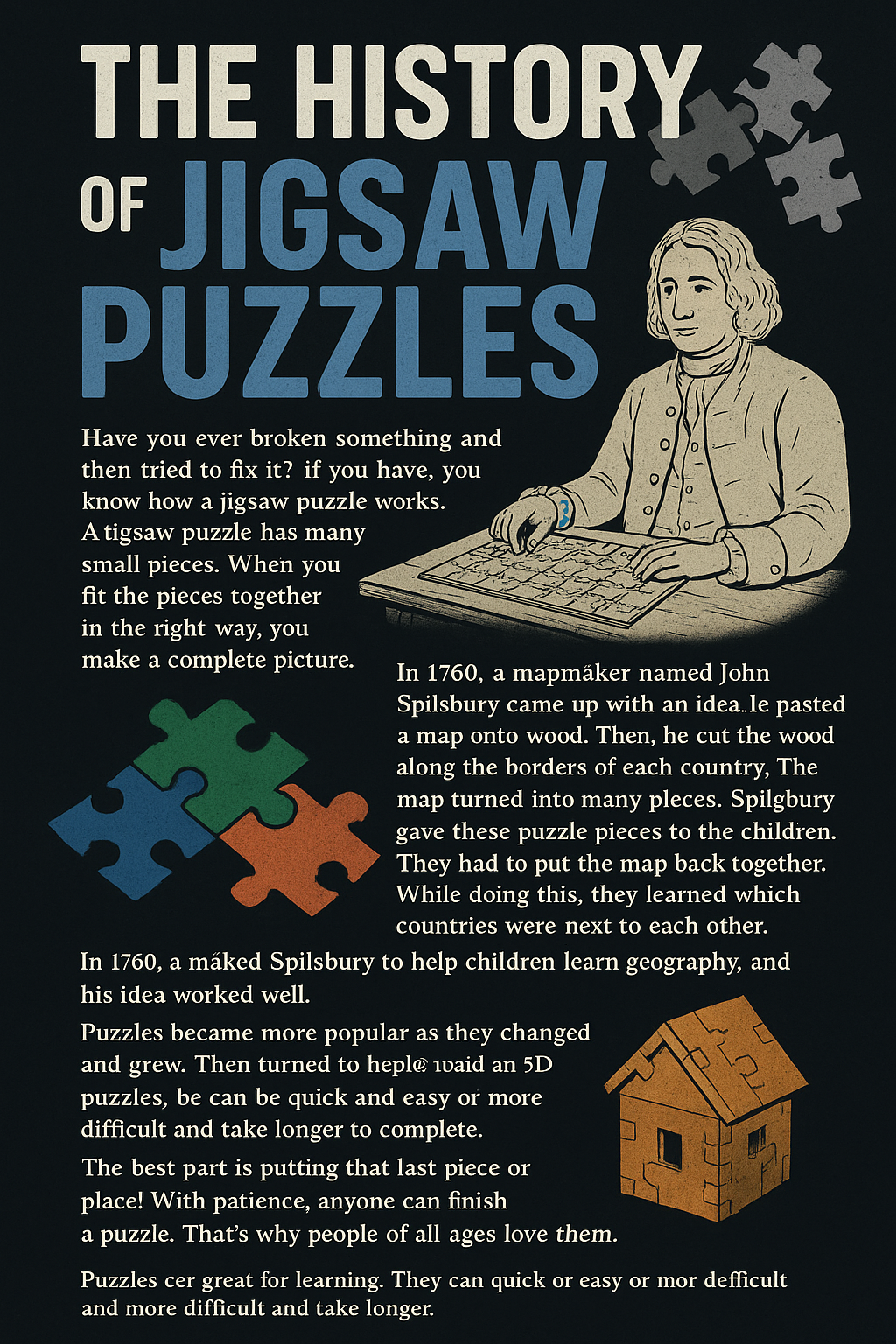
⸻
Have you ever broken something and then tried to fix it? If you have, you know how a jigsaw puzzle works. A jigsaw puzzle has many small pieces. When you fit the pieces together in the right way, you make a complete picture.
你有没有打碎过什么东西,然后试着把它修好?如果有,那你就知道拼图是怎么回事了。拼图由许多小块组成。把这些小块正确地拼在一起,就能组成一幅完整的图画。
⸻
In 1760, a mapmaker named John Spilsbury came up with an idea. He pasted (粘贴) a map onto wood. Then, he cut the wood along the borders of each country. The map turned into many pieces. Spilsbury gave these puzzle pieces to the children. They had to put the map back together. While doing this, they learned which countries were next to each other. Spilsbury wanted to help children learn geography, and his idea worked well.
1760年,一位名叫约翰·斯皮尔斯伯里的制图师想出了一个主意。他把一张地图粘贴在木板上,然后沿着每个国家的边界把木板切开。地图就变成了很多小块。斯皮尔斯伯里把这些拼图块给了孩子们。他们需要把地图重新拼起来。在这个过程中,他们学会了哪些国家是邻国。斯皮尔斯伯里的想法是帮助孩子学习地理,而他的想法效果很好。
⸻
Many people liked Spilsbury’s puzzles, so others started to make them too. They wanted to find faster ways to cut the pieces. A new tool called a jigsaw helped them do this. This saw made it easier to cut the shapes. After that, people started to call these puzzles jigsaw puzzles.
很多人喜欢斯皮尔斯伯里的拼图,于是其他人也开始制作。他们想找到更快的切割方法。一种叫做“jigsaw(线锯)”的新工具帮助他们实现了这个目标。这种锯子让切割图形变得更容易。从那以后,人们开始把这种拼图称为“jigsaw puzzles(拼图)”。
⸻
At first, making puzzles took a long time because people had to paste pictures on wood. But in the late 1800s, new dyes (染料) and less money needed for printing made it possible to produce the jigsaw puzzles much more quickly. As a result, more people started to buy them.
最初,制作拼图非常耗时,因为人们需要把图画粘贴在木板上。但在19世纪末,新染料的出现和印刷成本的降低,使得拼图的生产变得更快速。因此,越来越多的人开始购买拼图。
⸻
Puzzles became more popular as they changed and grew. The pictures were not just maps—they showed famous places, fairy tales, and more. Puzzles were cheap, and people could reuse them many times or trade them with friends. This made puzzles fun for everyone!
随着拼图的变化和发展,它变得越来越受欢迎。图案不再只是地图,还包括名胜古迹、童话故事等。拼图价格低廉,人们可以多次重复使用,或者和朋友交换。这让拼图变得人人都喜欢。
⸻
Puzzle makers then made something new: 3D puzzles. Instead of flat pictures, these puzzles let people build models (模型) that stood up, like houses. This added even more excitement.
之后,拼图制造商又发明了新产品:3D拼图。这种拼图不再是平面的图画,而是可以搭建成像房子那样立体的模型。这让拼图更具趣味性。
⸻
Puzzles are great for learning. They teach children about shapes, colours, and how to pay attention to a task. Completing puzzles also helps creative thinking and improves skills like reading maps. Even better, puzzles can make your memory stronger!
拼图对学习非常有益。它们可以教孩子认识形状、颜色,并学会专注于任务。完成拼图还能促进创造性思维,提高读图等技能。更棒的是,拼图还能增强记忆力!
⸻
Today, puzzles come in all sizes—some have just 10 pieces for kids, while others have 1,000 for adults. Puzzles can be quick and easy or more difficult and take longer to complete. The best part is putting that last piece in place! With patience, anyone can finish a puzzle. That’s why people of all ages love them!
如今,拼图有各种尺寸——有些儿童拼图只有10块,而成人拼图可以多达1000块。拼图可以简单快速,也可以难度较大、需要更长时间来完成。最精彩的时刻就是拼上最后一块拼图!只要有耐心,任何人都能完成拼图。这就是各个年龄段的人都喜欢拼图的原因!
词汇学习:
1. complete
中文:完整的
例句:When you fit the pieces together in the right way, you make a complete picture.
例句中文:当你把碎片正确拼在一起时,你就拼出了一幅完整的图画。
词根词缀:com-(一起)+ -plete(填满)
2. borders
中文:边界
例句:He cut the wood along the borders of each country.
例句中文:他沿着每个国家的边界切割木板。
词根词缀:来自拉丁词 bordure(边缘)
3. learn
中文:学习
例句:They learned which countries were next to each other.
例句中文:他们学会了哪些国家是相邻的。
词根词缀:古英语 leornian(获得知识)
4. tool
中文:工具
例句:A new tool called a jigsaw helped them do this.
例句中文:一种叫做线锯的新工具帮助他们完成了这件事。
词根词缀:古英语 tol(工具)
5. produce
中文:生产
例句:New dyes and less money needed for printing made it possible to produce jigsaw puzzles much more quickly.
例句中文:新染料和更低的印刷成本使得更快地生产拼图成为可能。
词根词缀:pro-(向前)+ -duce(引导、带来)
6. cheap
中文:便宜的
例句:Puzzles were cheap, and people could reuse them many times.
例句中文:拼图很便宜,人们可以反复使用很多次。
词根词缀:来自古英语 céap(交易、买卖)
7. trade
中文:交换
例句:People could trade them with friends.
例句中文:人们可以和朋友交换拼图。
词根词缀:来自古诺斯语 trað(路径,往来)
8. excitement
中文:兴奋
例句:This added even more excitement.
例句中文:这让人更加兴奋。
词根词缀:ex-(出)+ cite(唤起)+ -ment(名词后缀)
9. skills
中文:技能
例句:Completing puzzles helps improve skills like reading maps.
例句中文:完成拼图有助于提升像读图这样的技能。
词根词缀:来自古诺斯语 skil(区别、能力)
10. patience
中文:耐心
例句:With patience, anyone can finish a puzzle.
例句中文:有耐心的话,任何人都能完成拼图。
词根词缀:pat-(忍受)+ -ence(名词后缀)
