
- 初高中一词多义 81-100 第五组
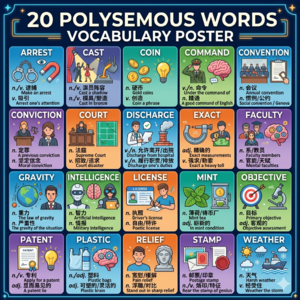
1. Arrest • v./n. 逮捕;拘留 | Make an arrest (实施逮捕) • v. 吸引(注意);阻止 | Arrest one's attention (吸引某人的注意) 2. Cast • n./v. 演员阵容;投掷 | Cast a shadow (投下阴影) • n./v. 模具;塑造 | Cast in bronze (用青铜铸造) 3. Coin • n. 硬币 | Gold coins (金币) • v. 创造(新词语);杜撰 | Coin a phrase (创造/杜撰一个短语) 4. Command • v./n. 命令;指挥 | Under the command of (在...的指挥下) • n. 掌握;精通 | A good command of English (精通英语) 5. Convention • n. 会议;大会 | Annual convention (年会) • n. 惯例;习俗;公约 | Social conventions (社会习俗) / Geneva Convention (日内瓦公约) 6. Conviction • n. 定罪;判罪 | A previous conviction (前科) • n. 坚定的信念;深信 | Moral conviction (道德信念) 7. Court • n. 法庭;球场 | Supreme Court (最高法院) • v. 招致;追求 | Court disaster (招致灾难/引火烧身) 8. Discharge • v./n. 允许离开;出院;退伍 | Discharge from hospital (出院) • v./n. 履行(职责);排放 | Discharge one's duties (履行职责) / Toxic discharge (有毒物质排放) 9. Exact • adj. 准确的;精确的 | Exact measurements (精确的测量) • v. 强求;勒索;迫使付出代价 | Exact a heavy toll (造成沉重的代价) 10. Faculty • n. (大学的)系;全体教员 | Faculty members (教职员工) • n. 官能;天赋;机能 | Mental faculties (心智能力) 11. Gravity • n. 重力;引力 | The law of gravity (万有引力定律) • n. 严重性;庄重 | The gravity of the situation (局势的严重性) 12. Intelligence • n. 智力;才智 | Artificial intelligence (人工智能) • n. 情报;情报机构 | Military intelligence (军事情报) 13. License • n. 执照;许可证 | Driver's license (驾照) • n. (偏离常轨的)自由;特许 | Poetic license (诗歌的特许/艺术创作的自由发挥) 14. Mint • n. 薄荷;铸币厂 | Mint tea (薄荷茶) • adj. 崭新的;完美的 | In mint condition (完好无损的/崭新状态的) 15. Objective • n. 目标;目的 | Primary objective (首要目标) • adj. 客观的;不带偏见的 | Objective assessment (客观的评估) 16. Patent • n./v. 专利;取得专利权 | Apply for a patent (申请专利) • adj. 显而易见的;明显的 | A patent lie (明显的谎言) 17. Plastic • n./adj. 塑料(的) | Plastic bags (塑料袋) • adj. 可塑的;灵活的 | Plastic brain (具有可塑性的大脑) 18. Relief • n. 宽慰;缓解;救济 | Pain relief (缓解疼痛) • n. 浮雕;鲜明对比 | Stand out in sharp relief (形成鲜明的对比/格外醒目) 19. Stamp • n. 邮票;印章 | Postage stamp (邮票) • n./v. 烙印;特征;标志 | Bear the stamp of genius (带有天才的印记) 20. Weather • n. 天气 | Harsh weather (恶劣的天气) • v. 经受住;平安度过(困难) | Weather the storm (渡过难关) 根据这些词帮我生成一个词汇海报 正方形的
4分钟 · 2
2 0
0 - 初高中一词多义 61-80 第四组
61. Attribute * n. 属性;特质 | A key attribute (关键特质) * v. 把…归因于 | Attribute success to hard work (把成功归因于努力) 62. Capacity * n. 容量;生产力 | Operating at full capacity (满负荷运转) * n. 身份;职位 | In an official capacity (以官方身份) 63. Credit * n. 信用;学分 | College credits (大学学分) * n./v. 赞许;功劳 | Take credit for (把…归功于自己) 64. Dictate * v. 听写;口述 | Dictate a letter (口述一封信) * v./n. 命令;决定 | Dictate the terms (决定条款/发号施令) 65. Disposition * n. 性情;性格 | A cheerful disposition (开朗的性格) * n. 处置;支配 | The disposition of assets (资产的处置) 66. Host * n. 主人;东道主 | Host country (主办国) * n. 许多;大量 | A host of problems (许多问题) 67. Impose * v. 把…强加于 | Impose one's will on others (把自己的意愿强加于人) * v. 征收(税、罚款等) | Impose a heavy tax (征收重税) 68. Invalid * adj. 无效的;站不住脚的 | An invalid argument (站不住脚的论点) * n. 病弱者;伤残人 (读音为 /ˈɪnvəlɪd/) | Care for an invalid (照顾病弱者) 69. Material * n./adj. 材料;物质的 | Material wealth (物质财富) * adj. 重要的;实质性的 | Material evidence (实质性证据) 70. Nature * n. 大自然 | Mother Nature (大自然) * n. 本质;天性 | Human nature (人性) 71. Obscure * adj. 模糊的;不出名的 | An obscure writer (不知名的作家) * v. 掩盖;使难理解 | Obscure the truth (掩盖真相) 72. Scale * n. 规模;程度 | On a large scale (大规模地) * n. 鳞片;音阶;天平 | Tip the scales (打破平衡) 73. Perspective * n. 视角;观点 | From my perspective (从我的视角来看) * n. 透视画法 | Draw in perspective (按透视法则绘画) 74. Provision * n. 提供;给养 | Provision of services (提供服务) * n. 条款;规定 | Under the provisions of the Act (根据该法案的规定) 75. Reflect * v. 反射;反映 | Reflect the reality (反映现实) * v. 深思;反省 (常接 on) | Reflect on one's behavior (反省某人的行为) 76. Secure * adj. 安全的;稳固的 | A secure job (稳定的工作) * v. 获得;争取到 | Secure a contract (争取到一份合同) 77. State * n. 状态;国家;州 | State of mind (心境/精神状态) * v. 陈述;声明 | State the facts clearly (清晰地陈述事实) 78. Suspend * v. 暂停;延缓 | Suspend a sentence (缓刑) / Suspend the meeting (暂停会议) * v. 悬挂 | Suspend from the ceiling (悬挂在天花板上) 79. Trace * v. 追溯;查出 | Trace the origins (追溯起源) * n. 痕迹;微量 | A trace of poison (微量的毒药) 80. Virtue * n. 美德;高尚品德 | Patience is a virtue (耐心是一种美德) * n. 优点;效力 | By virtue of (凭借/由于...的效力)
3分钟 ·90 - 初高中一词多义41-60 第三组
41. Apprehend * v. 逮捕;拘捕 | Apprehend a suspect (逮捕嫌疑人) * v. 理解;领会 | Apprehend the significance (领会其重要性) 42. Execute * v. 执行;实施 | Execute a plan (执行计划) * v. 处决 | Execute a prisoner (处决囚犯) 43. Champion * n. 冠军;优胜者 | Defending champion (卫冕冠军) * v. 捍卫;拥护 | Champion human rights (捍卫人权) 44. Qualification * n. 资格;学历 | Academic qualifications (学历证明) * n. 限制条件;保留意见 | Accept without qualification (毫无保留地接受) 45. Reserve * v./n. 预留;储备 | Foreign exchange reserves (外汇储备) * n. 矜持;内向;寡言 | A man of reserve (性格矜持的人) 46. Charge * n./v. 费用;指控 | Face criminal charges (面临刑事指控) * n. 负责;掌管 | In charge of the department (负责该部门) 47. Sound * n. 声音 | Sound waves (声波) * adj. 合理的;可靠的;健康的 | A sound argument (合理/站得住脚的论点) 48. Maintain * v. 维持;保养 | Maintain order (维持秩序) * v. 坚称;断言 | Maintain that he is innocent (坚称他是无辜的) 49. Yield * v./n. 产生(收益);产量 | Yield a profit (产生利润) * v. 屈服;让步 (常接to) | Yield to pressure (屈服于压力) 50. Draft * n./v. 草稿;起草 | The first draft (初稿) * n./v. 征兵;抽调 | Be drafted into the army (被征召入伍) 51. Check * v./n. 检查;核对 | Check the figures (核对数据) * v./n. 抑制;控制 | Keep inflation in check (控制通货膨胀) 52. Deposit * n./v. 存款;押金 | Pay a deposit (支付押金) * n. 沉积物;矿床 | Mineral deposits (矿产储量/矿床) 53. Economy * n. 经济;经济体 | Global economy (全球经济) * n. 节约;节俭 | Fuel economy (燃油经济性/节省燃料) 54. Harbor * n. 港口;避风港 | A safe harbor (安全的避风港) * v. 心怀,窝藏(通常指不良动机或情感) | Harbor a grudge (心怀怨恨) 55. Discriminate * v. 歧视 (常接against) | Discriminate against minorities (歧视少数群体) * v. 区分;辨别 (常接between) | Discriminate between right and wrong (明辨是非) 56. Pitch * n. 音高;运动场地 | A football pitch (足球场) * n./v. 推销;宣传;游说 | A sales pitch (推销说辞) 57. Institution * n. 机构;团体 | Financial institution (金融机构) * n. 制度;习俗 | The institution of marriage (婚姻制度) 58. Submit * v. 提交;呈递 | Submit an application (提交申请) * v. 屈服;顺从 (常接to) | Submit to authority (顺从权威) 59. Tolerate * v. 容忍;默许 | Tolerate poor behavior (容忍恶劣行为) * v. 对(药物、环境等)有耐受性 | Tolerate extreme heat (耐受酷热) 60. Elaborate * adj. 精心制作的;复杂的 | An elaborate design (复杂精美的设计) * v. 详细阐述 (常接on) | Elaborate on the plan (详细说明该计划)
4分钟 ·40 - 初高中一词多义 21-40 第二组
21. Contract * n. 合同;契约 | Sign a contract (签署合同) * v. 收缩;感染(疾病) | Contract a virus (感染病毒) / Contracting muscles (收缩肌肉) 22. Appreciate * v. 感激;欣赏 | Appreciate art (欣赏艺术) * v. 增值 | The currency appreciated (货币增值) 23. Conception * n. 构想;观念 | A vague conception (模糊的观念) * n. 怀孕;受孕 | Since the moment of conception (从受孕那一刻起) 24. Resolution * n. 决议;决心 | Pass a resolution (通过一项决议) * n. 解决 | Conflict resolution (冲突解决) 25. Provident * adj. 顾及未来的;深谋远虑的 | Provident measures (深谋远虑的措施) * adj. 节俭的 | A provident lifestyle (节俭的生活方式) 26. Observe * v. 观察;注意到 | Observe the behavior (观察行为) * v. 遵守(法律、习俗) | Observe the law (守法) 27. Assume * v. 假设;假定 | Assume the truth (假定事实) * v. 承担(责任);呈现(形态) | Assume responsibility (承担责任) 28. Facility * n. 设施;设备 | Medical facilities (医疗设施) * n. 熟练;天赋 | A facility for languages (语言天赋) 29. Abstract * adj. 抽象的 | Abstract concept (抽象概念) * n./v. 摘要;提取 | Abstract of a paper (论文摘要) 30. Project * n. 项目;工程 | Research project (研究项目) * v. 投影;预测;展现 | Project sales growth (预测销量增长) 31. Stock * n. 股票;库存 | Stock market (股票市场) * adj. 老掉牙的;陈腐的 | A stock answer (老套的回答) 32. Tender * adj. 温柔的;嫩的 | Tender meat (嫩肉) * n./v. 投标 | Submit a tender (递交标书) 33. Minute * n. 分钟 | Wait a minute (等一分钟) * adj. 极小的;微小的 (读作 /maɪˈnjuːt/) | Minute details (微小的细节) 34. Channel * n. 频道;渠道 | Distribution channel (分销渠道) * v. 引导;集中 | Channel energy into work (将精力投入工作) 35. Exhaust * v. 使精疲力竭;耗尽 | Exhaust resources (耗尽资源) * n. 废气;排气管 | Car exhaust (汽车尾气) 36. Interest * n. 兴趣 | Common interest (共同兴趣) * n. 利益;利息 | In the public interest (为了公共利益) 37. Standard * n./adj. 标准 | High standards (高标准) * n. 旗帜 | The royal standard (皇家旗帜) 38. Fine * adj. 好的;精细的 | Fine particles (微小颗粒) * n./v. 罚款 | Pay a fine (交罚款) 39. Mean * v. 意思是 | What do you mean? (你是什么意思?) * adj. 刻薄的;平庸的;平均的 | The mean temperature (平均气温) 40. Commission * n. 委员会;佣金 | European Commission (欧盟委员会) * v. 委托(创作、工作) | Commission a portrait (委托画一张肖像)
3分钟 ·180 - 初高中考过的一词多义 第一组
1. Agency * n. 代理机构;代办处 | Travel agency (旅行社) * n. 能动性;主体性 | Human agency (人的能动性) 2. Novel * n. 小说 | A classic novel (经典小说) * adj. 新颖的;异乎寻常的 | A novel approach (一种新颖的方法) 3. Appropriate * adj. 适当的;恰当的 | Appropriate behavior (得体的行为) * v. 拨出(款项);挪用;盗用 | Appropriate funds (拨款/挪用资金) 4. Sanction * n./v. 制裁 | Economic sanctions (经济制裁) * n./v. 批准;认可 | Official sanction (官方批准) 5. Discipline * n. 纪律;自制力 | Self-discipline (自律) * n. 学科;训练方法 | Academic discipline (学术学科) 6. Articulation * n. 清晰的表达 | Articulation of ideas (想法的清晰表达) * n. 关节;连接方式 | Joint articulation (关节连接) 7. Character * n. 性格;角色 | Moral character (道德品质) * n. 符号;字体 | Chinese characters (汉字) 8. Compromise * v./n. 妥协;让步 | Reach a compromise (达成妥协) * v. 危害;连累;损害 | Compromise national security (危害国家安全) 9. Subject * n. 主题;学科;主语 | The subject of the study (研究的主题) * adj. 受制于…的;易患…的 | Subject to change (易于改变的) 10. Critical * adj. 批评的;批判性的 | Critical thinking (批判性思维) * adj. 关键的;极其重要的 | A critical moment (关键时刻) 11. Constitution * n. 宪法 | Written constitution (成文宪法) * n. 体质;构成 | A strong constitution (强健的体质) 12. Address * n. 地址;演说 | Inaugural address (就职演说) * v. 解决;处理 | Address the issue (处理问题) 13. Engagement * n. 订婚;约定 | Prior engagement (已有约在先) * n. 参与度;投入 | Political engagement (政治参与) 14. Register * v./n. 登记;注册 | Register for a course (注册课程) * n. 语体;语域 | Formal register (正式语体) 15. Resolution * n. 决心;决议 | New Year’s resolution (新年计划) * n. 分辨率;清晰度 | High resolution (高分辨率) 16. Currency * n. 货币 | Foreign currency (外币) * n. 流传;通用 | Gain currency (流行起来) 17. Culture * n. 文化;文明 | Pop culture (流行文化) * n./v. 培养;培植 | Bacterial culture (细菌培养) 18. Account * n. 账户;描述 | An eyewitness account (目击者的叙述) * v. 解释;说明 (常接for) | Account for the failure (解释失败的原因) 19. Issue * n. 问题;议题 | Social issues (社会问题) * n./v. 发行;发布 | The latest issue (最新一期期刊) 20. Capital * n. 首都;大写字母 | Capital city (首府) * n. 资本;资金 | Human capital (人力资本)
4分钟 ·160 - Dog and Pony
### The Evolution of the "Dog and Pony Show" The idiom "dog and pony show" has its roots in late 19th and early 20th-century American culture. It originally referred to small, traveling circuses that lacked exotic animals like lions or elephants. Instead, these modest troupes relied on highly trained domestic animals—primarily dogs and ponies—to perform elaborate tricks to entertain rural audiences. While the performances were often charming, they were also seen as small-scale and somewhat over-rehearsed attempts to impress the public. “dog and pony show” 这个习语起源于 19 世纪末 20 世纪初的美国文化。它最初是指那些没有狮子、大象等珍稀动物的小型巡回马戏团。相反,这些规模不大的表演团体依靠训练有素的家畜——主要是狗和小马——为乡村观众表演精心设计的把戏。虽然这些演出往往很迷人,但也被视为一种小规模的、为了博取好感而进行的过度排练的表演。 In modern usage, the phrase has evolved into a common workplace metaphor with a cynical or skeptical undertone. It now describes a highly staged, flashy presentation or marketing event designed to sway an audience, often while masking a lack of real substance. For instance, if a company delivers a presentation filled with beautiful slides and grand promises but no concrete data, a skeptical observer might dismiss it as just another "dog and pony show". It serves as a reminder to look past the surface-level glitz and focus on the actual value being offered. 在现代用法中,这个短语演变成了一个带有讽刺或怀疑意味的常见职场比喻。它现在用来形容一场为了说服观众而精心策划、华而不实的演示或营销活动,且往往掩盖了缺乏实质内容的事实。例如,如果一家公司的汇报充满了精美的幻灯片和宏大的承诺,却没有任何具体数据,怀疑者可能会将其嗤之以鼻,认为这不过是又一场 “虚张声势的表演”。它提醒人们要看穿表面的虚华,专注于所提供的实际价值。 ### 1. 与“马戏团起源”相关的词汇 * Exotic [ɪɡˈzɒtɪk] * 含义:异国情调的、奇特的、珍稀的。 * 在文中的语境:最初的 "dog and pony show" 指的是那些规模较小、没有狮子或大象等**珍稀动物 (exotic animals)** 的巡回马戏团。 * Troupe [truːp] * 含义:(演员、歌手、马戏艺人的)表演团、剧团。 * 在文中的语境:文中指这些**规模不大的表演团体 (modest troupes)** 依靠训练有素的家畜来完成演出。 ### 2. 与“现代职场喻义”相关的词汇 * Cynical [ˈsɪnɪkl] & Skeptical [ˈskeptɪkl] * 含义: * Cynical:愤世嫉俗的、冷嘲热讽的、认为人皆自私的。 * Skeptical:怀疑的、不信的。 * 在文中的语境:在现代用法中,这个短语演变成了一个带有**冷嘲热讽 (cynical)** 或**怀疑 (skeptical)** 语气的职场隐喻。如果一个观察者认为某个展示只是在作秀,他会以怀疑的态度 (skeptical observer) 对其不予理会。 * Sway [sweɪ] * 含义:动摇、影响、说服。 * 在文中的语境:指那些华而不实的演示活动,其目的是为了**说服/动摇 (sway)** 观众,让他们接受某种观点或产品。 * Glitz [ɡlɪts] & Look past * 含义: * Glitz:炫目、浮华、华而不实。 * Look past:看穿、忽略表象去关注本质。 * 在文中的语境:文章提醒我们要**看穿 (look past)** 表面的**浮华 (glitz)**,去关注事物的核心实质。
1分钟 ·350 - The Red Tape 繁文缛节
The term red tape has its roots in the administrative practices of early modern Europe, particularly in Britain and Spain. Important legal and governmental documents were traditionally bound with red ribbon, a visible marker of their official status. Over time, these neatly tied bundles came to symbolize the slow and often cumbersome procedures required to process them. “red tape”这个词源于近代早期欧洲的行政惯例,尤其是在英国和西班牙。重要的法律文件和政府公文过去通常会用红色丝带捆绑起来,这是一种明显的官方身份标志。随着时间推移,这些整齐捆好的文件逐渐象征着处理它们所需的缓慢而繁琐的程序。 As bureaucratic systems expanded, so did public frustration. What once signified order and authority gradually took on a negative connotation, representing unnecessary delays and excessive formalities. Today, when people complain about red tape, they are not referring to literal ribbons, but to the inefficiencies embedded in complex administrative systems. 随着官僚体系不断扩张,公众的不满情绪也随之增长。曾经象征秩序和权威的事物,逐渐带上了负面的含义,代表着不必要的拖延和过多的形式主义。如今,当人们抱怨“red tape”时,他们指的早已不是字面意义上的红丝带,而是复杂行政系统中根深蒂固的低效率。 The phrase captures a universal experience: the sense that progress is being stalled not by real obstacles, but by layers of procedure. In this way, a simple piece of ribbon has evolved into a powerful metaphor for institutional inertia and the enduring challenge of balancing regulation with efficiency. 这个短语概括了一种普遍的体验:事情的推进并非被真正的障碍所阻挡,而是被层层叠叠的程序拖住了脚步。就这样,一条简单的红丝带逐渐演变成了制度惰性的有力隐喻,也象征着在规则监管与效率之间长期存在的平衡难题。
1分钟 ·200 - 鱼 不存在
Why Fish Don’t Exist by Lulu Miller is a genre-blending book that combines biography, science writing, and personal memoir. It centers on the life of David Starr Jordan, a pioneering taxonomist who devoted himself to classifying fish and bringing order to the natural world. The narrative follows Jordan’s relentless efforts to rebuild his collection after repeated disasters, portraying him as a man determined to impose structure on chaos. At the same time, Miller weaves in her own struggles with uncertainty and loss, using Jordan’s story as a lens to explore larger philosophical questions. A key idea in the book is that “fish” does not exist as a scientifically valid category, challenging the assumption that the world can be neatly organized. This concept becomes a metaphor for the fragility of human-made systems and beliefs. As the story unfolds, Miller also confronts the darker aspects of Jordan’s legacy, particularly his connection to eugenics, which complicates his image as a purely admirable figure. Ultimately, the book examines how people respond to disorder and meaninglessness. Rather than offering simple answers, it suggests that meaning is not found in rigid classifications, but created through curiosity, resilience, and human connection. 《鱼不存在》(Why Fish Don’t Exist)是Lulu Miller创作的一本融合了人物传记、科普写作和个人回忆的作品。全书围绕David Starr Jordan展开,他是一位致力于为鱼类分类、试图为自然世界建立秩序的科学家。 书中讲述了Jordan在多次灾难后仍不断重建自己鱼类标本收藏的经历,展现了他试图在混乱中建立结构与秩序的执着。同时,作者也穿插了自己在人生中面对不确定性与失落的体验,使整本书不仅是传记,更带有强烈的个人思考色彩。 本书的一个核心观点是:“鱼”在科学分类上并不是一个严格成立的类别,这一结论挑战了人们对世界可以被清晰划分的认知,也象征着许多人类建立的体系其实是脆弱甚至带有幻象的。随着叙述推进,作者还揭示了Jordan与优生学的关联,使这一人物形象变得更加复杂。 最终,这本书探讨的是人在混乱与无序面前如何回应。它并没有给出简单答案,而是指出:意义并不来自僵化的分类体系,而是源于人的好奇心、韧性以及人与人之间的连接。 1. pioneer /ˌpaɪəˈnɪə(r)/ 中文:先驱;开拓者;开创 用法:可作名词或动词 搭配:pioneer in sth / pioneer a new method / a pioneer of science 例句:He is a pioneer in modern medicine. 他是现代医学的先驱。 ⸻ 2. portrait /ˈpɔːtreɪt/ 中文:肖像;画像;描写 用法:名词 搭配:paint a portrait / a portrait of sb / literary portrait 例句:The artist painted a portrait of the queen. 这位画家为女王画了一幅肖像。 ⸻ 3. image /ˈɪmɪdʒ/ 中文:形象;图像;印象 用法:名词 搭配:public image / create an image / mental image 例句:The company wants to improve its public image. 这家公司想改善其公众形象。 ⸻ 4. taxonomist /tækˈsɒnəmɪst/ 中文:分类学家 用法:名词(生物学术语) 搭配:plant taxonomist / animal taxonomist / leading taxonomist 例句:The taxonomist studies how species are classified. 这位分类学家研究物种是如何被分类的。 ⸻ 5. fragility /frəˈdʒɪləti/ 中文:脆弱;易碎;脆弱性 用法:名词 搭配:emotional fragility / fragility of life / structural fragility 例句:The glass shows the fragility of the material. 这块玻璃显示了这种材料的脆弱性。 ⸻ 6. confront /kənˈfrʌnt/ 中文:面对;直面;对抗 用法:动词 搭配:confront a problem / confront reality / be confronted with 例句:We must confront the challenges ahead. 我们必须直面未来的挑战。 ⸻ 7. eugenics /juːˈdʒenɪks/ 中文:优生学(有争议的学说) 用法:名词(不可数) 搭配:the theory of eugenics / support eugenics / eugenics movement 例句:Eugenics was widely criticized for its ethical problems. 优生学因其伦理问题而受到广泛批评。 ⸻
1分钟 ·260 - 阿尔忒弥斯二号
Artemis II: Humanity’s Return to Lunar Orbit In an era defined by rapid technological progress, NASA’s Artemis II mission marks a bold step back to the Moon—this time with a fresh purpose. As the first crewed flight in the Artemis program, Artemis II is designed to carry astronauts aboard the Orion spacecraft on a journey around the Moon, reviving a path last taken during the Apollo era. Unlike its predecessor, Artemis I, which flew uncrewed, this mission places human presence at the center of deep-space exploration once again. The astronauts will travel thousands of kilometers beyond low Earth orbit, testing life-support systems, navigation, and communication technologies in the harsh environment of space. Their journey is not merely symbolic; it lays the groundwork for future lunar landings and long-term exploration. What sets Artemis II apart is its broader vision. It is not just about revisiting the Moon, but about establishing a sustainable human presence beyond Earth. The mission also represents international cooperation and a renewed global interest in space exploration. As the Orion spacecraft loops around the Moon and heads back to Earth, it carries more than just a crew—it carries humanity’s ambition to explore farther, stay longer, and ultimately push toward Mars. 阿尔忒弥斯2号:人类重返月球轨道 在一个科技飞速发展的时代,NASA的阿尔忒弥斯2号任务标志着人类重返月球的重要一步——而这一次有着全新的目标。作为阿尔忒弥斯计划中的首次载人飞行任务,阿尔忒弥斯2号将搭载宇航员乘坐“猎户座”(Orion)飞船绕月飞行,重走人类在阿波罗时代曾经走过的轨迹。 与其前一次任务阿尔忒弥斯1号(无人飞行)不同,这次任务将再次把“人”带回深空探索的核心位置。宇航员将飞出近地轨道,进入更遥远的深空环境,在极端条件下测试生命保障系统、导航系统以及通信技术。这次旅程不仅具有象征意义,更为未来的登月任务和长期太空探索打下基础。 阿尔忒弥斯2号的特别之处在于它更宏大的愿景。它不仅仅是“重返月球”,而是为了在地球之外建立可持续的人类活动。与此同时,这项任务也体现了国际合作的加强,以及全球范围内对太空探索兴趣的再次升温。 当“猎户座”飞船绕月飞行并返回地球时,它承载的不只是宇航员,更承载着人类探索更远宇宙、停留更久,并最终迈向火星的雄心。
1分钟 ·200 - 英文的演变和发展
English didn’t just appear overnight—it’s the result of centuries of mixing, borrowing, and reshaping. It all started in the 5th century, when Germanic tribes like the Angles, Saxons, and Jutes invaded Britain. They brought their own dialects, which eventually became Old English. The original Celtic languages didn’t disappear completely, but they left only a small mark, mainly in place names. Then came the Vikings. They spoke Old Norse and added everyday words like sky, skill, and skin, as well as pronouns like they and them. Their influence wasn’t massive in quantity, but it definitely shaped how English sounds and works. The real game-changer happened in 1066, when the Normans invaded. French became the language of power—government, law, and the upper class. That’s why English today has pairs like cow (animal) and beef (food). English basically became a mix of Germanic roots and French vocabulary. By the time of Chaucer, English was finally being used in serious writing. Then the printing press came along in the 15th century, helping to spread and standardize the language, even though spelling was still all over the place. During the Renaissance, English exploded with new words, many borrowed from Latin. Meanings also shifted—for example, fact went from “something done” to “something true.” So modern English is really a patchwork language—built layer by layer, shaped by history, invasion, and culture. 英语并不是一夜之间出现的,它是经过几个世纪不断融合、借用和演变形成的。 一切始于5世纪,当时盎格鲁人、撒克逊人和朱特人等日耳曼部落入侵不列颠。他们带来了自己的方言,这些方言逐渐发展成为古英语。原本的凯尔特语言并没有完全消失,但只留下了很小的影响,主要体现在地名上。 接着是维京人的到来。他们使用古诺斯语,为英语带来了像 sky(天空)、skill(技能)、skin(皮肤)这样的日常词汇,以及 they、them 这样的代词。虽然他们带来的词汇数量不算多,但对英语的发音和结构产生了重要影响。 真正的转折点出现在1066年诺曼征服时期。法语成为统治阶级、政府和法律领域的语言。这就是为什么英语中会出现像 cow(动物)和 beef(食物)这样的词汇对。英语逐渐变成了一个融合了日耳曼词根和法语词汇的语言。 到了乔叟时代,英语终于被用于严肃的文学创作。随后,15世纪印刷术的引入推动了语言的传播和标准化,尽管当时的拼写仍然非常混乱。 在文艺复兴时期,英语词汇迅速扩展,大量词汇来自拉丁语。同时,一些词义也发生了变化,例如 fact 从“做过的事情”变成了“真实的事情”。 因此,现代英语其实是一种“拼接式”的语言,是在历史、入侵和文化影响下,一层一层发展形成的。 1. appear /əˈpɪə(r)/(中考) ① 出现;显现 • A star appeared in the sky. 天空中出现了一颗星星。 ② 似乎;看起来 • She appears to be tired. 她似乎很累。 🔹搭配:appear suddenly / appear to do ⸻ 2. influence /ˈɪnfluəns/(中考) ① n. 影响 • His teacher had a great influence on him. 他的老师对他影响很大。 ② v. 影响 • Music can influence people’s mood. 音乐可以影响人的情绪。 🔹搭配:have an influence on / be influenced by ⸻ 3. dialect /ˈdaɪəlekt/(高考) n. 方言(某一地区的语言变体) • People in this village speak a local dialect. 这个村子的人讲地方方言。 🔹考点:区别 language(语言) vs dialect(方言) ⸻ 4. pronoun /ˈprəʊnaʊn/(高考) n. 代词(代替名词的词) • “He” and “they” are pronouns. he 和 they 是代词。 🔹分类:personal pronouns(人称代词) ⸻ 5. Renaissance /rɪˈneɪsəns/(高考) n. 文艺复兴(欧洲文化复兴时期) • Many new ideas appeared during the Renaissance. 文艺复兴时期出现了许多新思想。 🔹引申:a renaissance of…(……的复兴) ⸻ 6. patchwork /ˈpætʃwɜːk/(高考) ① n. 拼布;拼接物 ② 比喻:混合体(重点) • English is a patchwork of many languages. 英语是多种语言的混合体。 🔹高级表达:a patchwork of cultures / ideas ⸻
2分钟 ·210 - 中世纪英文对身体部位的回避
The term “dark meat” has an interesting origin rooted in both language history and cultural sensitivity. In medieval and early modern England, especially during the Victorian era, people often avoided directly naming certain body parts in polite conversation. Words like leg and breast were considered too explicit or even improper in refined society. As a result, euphemisms developed. When referring to poultry at the dining table, instead of saying leg or breast, people began to use more indirect and socially acceptable terms. The meat from the legs and thighs of animals, which appears darker due to higher levels of myoglobin (a protein that stores oxygen in muscles), came to be called “dark meat.” In contrast, the lighter-colored breast meat was labeled “white meat.” Over time, these terms lost their original function as euphemisms and became standard culinary vocabulary. Today, “dark meat” is no longer about politeness but about texture, flavor, and nutritional differences. Dark meat is generally juicier and richer in taste, reflecting the more active muscles of the animal. This linguistic shift shows how social norms can shape language, and how words that begin as indirect expressions can eventually become neutral, technical terms in everyday use. “dark meat(深色肉)”这个词的来源,既与语言历史有关,也反映了特定的文化背景。 在中世纪以及近代早期的英国,尤其是维多利亚时期,人们在正式场合往往避免直接提及某些身体部位。像 leg(腿) 和 breast(胸) 这样的词,在当时被认为过于直白,甚至有些不雅。因此,人们开始使用委婉语来替代这些表达。 在餐桌上谈论禽类时,人们不再直接说 leg 或 breast,而是采用更含蓄、更礼貌的说法。由于动物的腿部和大腿肌肉中含有较多的肌红蛋白(myoglobin,一种储存氧气的蛋白质),这些部位的肉颜色较深,于是就被称为 “dark meat(深色肉)”;相对地,颜色较浅的胸肉则被称为 “white meat(白肉)”。 随着时间的推移,这些表达逐渐失去了原本作为委婉语的功能,转而成为标准的烹饪术语。如今,“dark meat”不再与礼貌或避讳有关,而更多用于描述肉的质地、风味和营养差异。深色肉通常更加多汁、味道更浓郁,这也与这些部位肌肉活动更多有关。 这一词汇的演变表明,社会习俗会深刻影响语言的发展,而原本出于含蓄表达而产生的词语,最终也可能演变为日常中性甚至专业化的术语。 original / əˈrɪdʒənl / adj. 原来的;最初的;独创的 用法:original idea / original plan / the original meaning 例句:This is the original version of the story. 这是这个故事的最初版本。 consider / kənˈsɪdə(r) / v. 考虑;认为 用法:consider doing / consider sb. (to be) / take sth. into consideration 例句:You should consider taking more exercise. 你应该考虑多锻炼。 improper / ɪmˈprɒpə(r) / adj. 不合适的;不礼貌的 用法:improper behavior / improper use 例句:It is improper to speak loudly in public. 在公共场合大声说话是不合适的。 explicit / ɪkˈsplɪsɪt / adj. 明确的;直白的(常指不加掩饰) 用法:explicit explanation / explicit content 例句:The teacher gave explicit instructions. 老师给出了明确的指示。 euphemism / ˈjuːfəmɪzəm / n. 委婉语(用温和表达代替直接说法) 用法:use a euphemism for / common euphemisms 例句:“Pass away” is a euphemism for “die.” “去世”是“死亡”的一种委婉说法。 myoglobin / ˌmaɪəˈɡləʊbɪn / n. 肌红蛋白(存在于肌肉中,影响肉的颜色) 用法:levels of myoglobin / contain myoglobin 例句:Dark meat contains more myoglobin than white meat. 深色肉比白肉含有更多的肌红蛋白。
1分钟 ·220 - 北美校车法规
In the United States, school buses are granted what is often described as an “absolute right of way,” a rule designed to protect one of the most vulnerable groups on the road—children. When a school bus stops to load or unload students, it activates flashing red lights and extends a stop arm. At that moment, all nearby vehicles are required to come to a complete stop, regardless of direction, unless there is a physical median separating the lanes. This rule may seem strict, but it reflects a deeper principle: safety must always take precedence over convenience. Children are unpredictable; they may suddenly cross the street without checking for traffic or become distracted. By forcing all vehicles to stop, the law creates a temporary safety zone where children can move freely without the immediate threat of passing cars. The penalties for violating this rule are severe, including heavy fines, points on a driver’s license, and even license suspension. These consequences are not meant to punish drivers harshly, but to deter behavior that could lead to tragic accidents. Ultimately, the school bus law is a powerful reminder that responsible driving is not just about following rules, but about protecting lives. When a school bus stops, traffic stops—no exceptions. This simple principle helps ensure that every child can travel to and from school safely. ⸻ 🇨🇳 中文翻译 在美国,校车被赋予一种被称为“绝对路权”的特殊权利,这一规定旨在保护道路上最脆弱的群体之一——儿童。当校车停下来让学生上下车时,它会打开红色闪光灯并伸出停牌。在这一刻,除非道路中间有物理隔离带,否则所有车辆,无论方向,都必须完全停车。 这一规定看似严格,但它体现了一个更深层的原则:安全永远优先于便利。儿童具有不可预测性,他们可能突然横穿马路而不观察交通情况,或者因为分心而忽视危险。通过强制所有车辆停车,法律为孩子们创造了一个临时的安全区域,使他们能够在没有车辆威胁的情况下自由通行。 违反这一规定的处罚非常严厉,包括高额罚款、驾照扣分,甚至可能被吊销驾照。这些惩罚并非单纯为了严厉制裁驾驶员,而是为了阻止可能导致悲剧事故的行为。 归根结底,校车法律提醒我们,负责任的驾驶不仅仅是遵守规则,更是保护生命。当校车停下时,所有车辆必须停下——没有例外。正是这一简单的原则,保障了每一个孩子能够安全往返学校。 📘 中考词汇 1. design /dɪˈzaɪn/ 中文:设计;计划 用法:design sth / design for sth 例句:The system is designed to protect children. 这个系统是为了保护儿童而设计的。 ⸻ 2. load /ləʊd/ 中文:装载;负担;(上下车)载人 用法:load…with / load…into 例句:The bus is loading students at the stop. 校车正在站点接学生上车。 ⸻ 3. strict /strɪkt/ 中文:严格的 用法:be strict with sb / be strict about sth 例句:The law is very strict about road safety. 法律对道路安全要求非常严格。 ⸻ 4. reflect /rɪˈflekt/ 中文:反映;体现 用法:reflect sth / reflect on sth 例句:This rule reflects the importance of safety. 这条规则体现了安全的重要性。 ⸻ 📗 高考词汇 5. grant /ɡrɑːnt/ 中文:授予;给予(权利) 用法:grant sb sth / grant permission / grant rights 例句:The law grants school buses special rights. 法律赋予校车特殊权利。 ⸻ 6. vulnerable /ˈvʌlnərəbl/ 中文:脆弱的;易受伤害的 用法:be vulnerable to sth 例句:Children are vulnerable to traffic accidents. 儿童容易受到交通事故的伤害。 ⸻ 7. median /ˈmiːdiən/ 中文:(道路)中央隔离带 用法:a raised median / central median 例句:Cars on the other side of the median may continue. 在隔离带另一侧的车辆可以继续行驶。 ⸻ 8. suspension /səˈspenʃən/ 中文:暂停;(驾照)吊销 用法:license suspension / suspend a license 例句:He faced a license suspension for breaking the rule. 他因违反规定面临驾照吊销。 ⸻ 9. deter /dɪˈtɜː(r)/ 中文:阻止;威慑 用法:deter sb from doing sth 例句:Heavy fines are used to deter drivers from speeding. 高额罚款用来阻止司机超速。
2分钟 ·210 - 哈勃张力
The Hubble Tension has emerged as one of the most intriguing problems in modern Cosmology. It refers to a persistent disagreement in the value of the Hubble constant, the parameter that describes how fast the universe is expanding. Surprisingly, two highly reliable methods yield conflicting results. On the one hand, scientists analyze the Cosmic Microwave Background, the faint afterglow of the early universe. By studying tiny fluctuations in this radiation and applying well-established physical laws, researchers can infer the expansion rate of the universe. This method suggests a slower expansion, with a value of about 67 kilometers per second per megaparsec. On the other hand, astronomers directly observe the present-day universe using distance indicators such as Cepheid variable stars and Type Ia supernovae. These “standard candles” allow scientists to measure distances to faraway galaxies and determine how fast they are moving away from us. This approach consistently produces a higher value, around 73 to 74 kilometers per second per megaparsec. The tension between these results is not trivial. It exceeds the expected margin of error, suggesting that something fundamental may be missing from our current understanding of the universe. Whether it points to unknown systematic errors or entirely new physics, the Hubble Tension challenges the standard cosmological model and opens the door to deeper discoveries about the nature of reality. ⸻ 中文翻译 “哈勃张力”已经成为现代宇宙学中最引人关注的问题之一。它指的是哈勃常数这一参数的测量结果长期存在不一致,而哈勃常数描述的是宇宙膨胀的速度。令人惊讶的是,两种高度可靠的方法却得出了相互矛盾的结果。 一方面,科学家通过分析宇宙微波背景——也就是早期宇宙留下的微弱余辉——来研究宇宙。他们通过研究其中极其细微的温度波动,并结合成熟的物理理论,推算出宇宙的膨胀速度。这种方法得到的结果较低,大约为每百万秒差距67千米每秒。 另一方面,天文学家通过观测当今宇宙,利用造父变星和Ia型超新星等“标准烛光”来直接测量距离。这些天体可以帮助科学家确定遥远星系与我们的距离,并计算它们远离我们的速度。这种方法得到的结果较高,大约为每百万秒差距73到74千米每秒。 这种差异并非微不足道,它已经超过了统计误差范围。这意味着,我们目前对宇宙的理解可能还不完整。无论这是由于未知的系统误差,还是暗示着全新的物理规律,哈勃张力都在挑战现有的宇宙学模型,并为我们进一步探索宇宙的本质提供了重要契机。 中考词汇: persistent /pəˈsɪstənt/ adj. 持续的;坚持的 搭配:persistent problem / persistent effort 例句:The problem is persistent and hard to solve.(这个问题一直存在,很难解决。) expand /ɪkˈspænd/ v. 扩大;扩张 搭配:expand rapidly / expand the market 例句:The universe continues to expand over time.(宇宙随着时间不断膨胀。) conflicting /kənˈflɪktɪŋ/ adj. 相互矛盾的;冲突的 搭配:conflicting results / conflicting opinions 例句:The two reports show conflicting results.(这两份报告结果相互矛盾。) 高考词汇: intriguing /ɪnˈtriːɡɪŋ/ adj. 引人入胜的;耐人寻味的 搭配:intriguing question / intriguing idea 例句:This is an intriguing mystery in science.(这是一个引人入胜的科学谜题。) parameter /pəˈræmɪtə(r)/ n. 参数;界限 搭配:key parameter / set parameters 例句:The Hubble constant is an important parameter.(哈勃常数是一个重要参数。) fluctuation /ˌflʌktʃuˈeɪʃn/ n. 波动;起伏 搭配:temperature fluctuation / price fluctuation 例句:Small fluctuations can affect the result.(微小的波动会影响结果。) indicator /ˈɪndɪkeɪtə(r)/ n. 指标;标志 搭配:economic indicator / key indicator 例句:The light is an indicator of the machine’s status.(这个灯是机器状态的指示。) exceed /ɪkˈsiːd/ v. 超过;超出 搭配:exceed expectations / exceed the limit 例句:The result exceeds our expectations.(结果超出了我们的预期。)
2分钟 ·330 - 为什么冰球比赛可以打架?
Ice hockey is one of the few modern sports where fighting is still tolerated, and this unusual feature is deeply rooted in its history and culture. In the early days of hockey, there were fewer formal rules and limited referee intervention. As a result, players often relied on themselves to resolve conflicts on the ice. This led to the development of what is known as a “self-policing” system, in which players would respond directly to dangerous or unfair behavior. Over time, fighting became an accepted, though regulated, part of the game, especially in professional leagues such as the NHL. While players who fight are penalized with a five-minute major penalty, referees may allow fights to continue briefly under controlled conditions. This reflects a balance between discipline and tradition. Culturally, hockey—particularly in countries like Canada—places a strong emphasis on toughness and resilience. The role of the “enforcer,” a player responsible for protecting teammates and responding to aggression, further illustrates how fighting has been integrated into the sport’s identity. For many fans, it also adds excitement and intensity to the game. However, in recent years, attitudes have begun to shift. Concerns about player safety, especially brain injuries, have led to stricter regulations and a gradual decline in fighting. Despite this, its historical and cultural significance continues to shape how the sport is played and perceived today. ⸻ 冰球是少数仍然容忍打架的现代运动之一,而这一特殊现象深深植根于其历史与文化之中。在冰球发展的早期阶段,比赛规则较少,裁判的干预也十分有限。因此,球员往往依靠自己来解决场上的冲突,这逐渐形成了一种所谓的“自我执法”机制,即球员通过直接回应危险或不公平行为来维持秩序。 随着时间的推移,打架逐渐成为比赛中被接受但受到限制的一部分,尤其是在像NHL这样的职业联赛中。虽然参与打架的球员会被判罚五分钟的大罚,但裁判在特定情况下会允许打架短暂进行,从而在纪律与传统之间取得一种平衡。 从文化角度来看,在加拿大等国家,冰球强调强硬与坚韧的精神。“打手”(enforcer)这一角色的存在,正体现了打架在这项运动中的地位——他们负责保护队友并回应对方的攻击。对许多观众而言,这也为比赛增添了紧张感与观赏性。 然而,近年来,人们的态度正在发生变化。随着对球员安全,尤其是脑部损伤问题的关注增加,相关规则也日趋严格,打架现象逐渐减少。尽管如此,其历史与文化意义仍然深刻影响着这项运动的规则与认知。 📘 中考词汇 1️⃣ tolerate /ˈtɒləreɪt/ 词性:v. 中文:容忍;忍受 搭配: tolerate sth / tolerate doing sth tolerate bad behavior 例句: • We cannot tolerate such rude behavior. 我们不能容忍这种粗鲁的行为。 • She can’t tolerate being interrupted. 她无法忍受被打断。 考点: • 后面常接 doing(动名词) • ≈ put up with(口语) ⸻ 2️⃣ limit /ˈlɪmɪt/ 词性:n./v. 中文:限制;极限 搭配: set a limit / limit sth / time limit 例句: • There is a time limit for this test. 这次考试有时间限制。 • The teacher limited the use of phones. 老师限制了手机的使用。 考点: • limit to(把……限制在) • without limit(无限地) ⸻ 3️⃣ resolve /rɪˈzɒlv/ 词性:v. 中文:解决;下定决心 搭配: resolve a problem / resolve to do sth 例句: • They finally resolved the conflict. 他们最终解决了冲突。 • He resolved to study harder. 他下定决心更加努力学习。 考点: • 两个意思:解决 + 决心 • resolve to do(固定结构) ⸻ 📙 高考词汇 4️⃣ intervention /ˌɪntəˈvenʃn/ 词性:n. 中文:干预;介入 搭配: government intervention / medical intervention 例句: • The government’s intervention helped the economy. 政府的干预帮助了经济。 • Early intervention can save lives. 早期干预可以挽救生命。 考点: • 来自 intervene(介入) • 常用于正式语境(政治/医学/社会) ⸻ 5️⃣ resilience /rɪˈzɪliəns/ 词性:n. 中文:韧性;恢复力 搭配: mental resilience / show resilience 例句: • She showed great resilience after failure. 她在失败后表现出极强的恢复力。 • Children often have strong resilience. 孩子通常具有很强的适应能力。 考点: • 抽象名词(常考阅读) • ≈ ability to recover ⸻ 6️⃣ penalty /ˈpenəlti/ 词性:n. 中文:惩罚;罚款;点球 搭配: pay a penalty / penalty for sth / a heavy penalty 例句: • He paid a penalty for breaking the rules. 他因违反规则受到了惩罚。 • The player got a penalty in the game. 那名球员在比赛中被判罚。 考点: • 体育语境:点球 / 判罚 • penalty for doing sth(因……受罚)
2分钟 ·250 - 决定寿命的基因
FOXO3 is one of the most important genes associated with human longevity. It belongs to a family of genes that produce transcription factors, proteins that regulate how other genes are expressed. In simple terms, FOXO3 acts like a cellular “commander,” helping cells respond to stress and maintain stability over time. One of the key functions of FOXO3 is to protect cells from damage. It plays a major role in reducing oxidative stress by activating antioxidant defenses, which neutralize harmful free radicals. In addition, FOXO3 is involved in DNA repair, ensuring that genetic material remains stable and functional. When cells are severely damaged, it can even trigger apoptosis, a process that removes faulty cells and prevents diseases such as cancer. Scientific studies have shown that certain variants of the FOXO3 gene are more common in people who live exceptionally long lives, such as centenarians. This suggests that genetics plays a crucial role in determining lifespan. However, lifestyle factors also influence FOXO3 activity. Regular exercise, calorie restriction, and healthy habits may enhance its protective effects. Overall, FOXO3 represents a key link between genetics and aging, offering valuable insights into how humans might live longer and healthier lives. FOXO3 是与人类长寿密切相关的最重要基因之一。它属于一类能够产生转录因子的基因,这些蛋白质负责调控其他基因的表达。简单来说,FOXO3 就像细胞中的“指挥官”,帮助细胞应对压力并在长期内维持稳定。 FOXO3 的一个关键功能是保护细胞免受损伤。它在减少氧化压力方面起着重要作用,通过激活抗氧化防御系统来中和有害的自由基。此外,FOXO3 还参与 DNA 修复,确保遗传物质保持稳定和正常功能。当细胞受到严重损伤时,它甚至可以触发细胞凋亡(apoptosis),从而清除异常细胞,预防癌症等疾病的发生。 科学研究表明,在一些特别长寿的人群(如百岁老人)中,某些 FOXO3 基因变体更为常见。这表明基因在决定寿命方面起着关键作用。然而,生活方式同样会影响 FOXO3 的活性。规律运动、限制热量摄入以及健康的生活习惯,都可能增强它的保护作用。 总体来看,FOXO3 构建了基因与衰老之间的重要联系,为人类如何活得更长、更健康提供了宝贵的科学启示。 1. gene /dʒiːn/ n. 基因 搭配:carry a gene / genetic disease 例句:Some people carry genes that protect them from illness. 翻译:有些人携带可以抵抗疾病的基因。 2. factor /ˈfæktə(r)/ n. 因素 搭配:key factor / main factor / contributing factor 例句:Exercise is an important factor in staying healthy. 翻译:锻炼是保持健康的重要因素。 3. respond to v. 对……作出反应 搭配:respond to stress / respond to changes 例句:Cells respond to stress in different ways. 翻译:细胞对压力会有不同的反应。 4. offer /ˈɒfə(r)/ v. 提供 搭配:offer help / offer protection / offer a solution 例句:This diet may offer protection against disease. 翻译:这种饮食可能提供对疾病的保护。 ⸻ 5. longevity /lɒnˈdʒevəti/ n. 长寿 搭配:human longevity / promote longevity 例句:Scientists study the secrets of human longevity. 翻译:科学家研究人类长寿的秘密。 6. transcription /trænˈskrɪpʃən/ n. 转录(生物学) 搭配:gene transcription / transcription factor 例句:FOXO3 is involved in gene transcription. 翻译:FOXO3 参与基因转录过程。 7. cellular /ˈseljələ(r)/ adj. 细胞的 搭配:cellular function / cellular damage 例句:Exercise improves cellular function. 翻译:运动可以改善细胞功能。 8. oxidative /ˈɒksɪdeɪtɪv/ adj. 氧化的 搭配:oxidative stress / oxidative damage 例句:Oxidative stress can speed up aging. 翻译:氧化压力会加速衰老。 9. antioxidant /ˌæntiˈɒksɪdənt/ n./adj. 抗氧化物;抗氧化的 搭配:antioxidant defense / antioxidant foods 例句:Fruits are rich in antioxidants. 翻译:水果富含抗氧化物质。 10. apoptosis /ˌæpɒpˈtəʊsɪs/ n. 细胞凋亡 搭配:trigger apoptosis / programmed cell death 例句:Apoptosis helps remove damaged cells. 翻译:细胞凋亡有助于清除受损细胞。
2分钟 ·200