

 1965
1965 0
0How to Protect Your Focus and Reach 'Flow State'
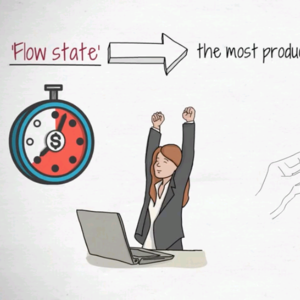
The lack of focus is truly an epidemic. Most people haven't even experienced the power of 'flow state' – the most productive state we can be in – because of the continuous distractions and interruptions. With this video, however, you'll be equipped with the right tools and habits to protect your focus and reach 'flow state' more often.
Removing the Two Forms of Distractions
Step 1: Blocking External Distractions
The first step to protecting your focus is to identify the biggest sources of external distractions that hijack your attention. The most common forms of external distractions are: smartphones, social media, food, Netflix, email, video games and instant messaging apps.
If distractions are easily accessible, however, you will get distracted. That's because distractions, such as smartphones, social media, news websites, and Netflix, are designed to get you addicted. They're designed to stimulate your brain in unnatural ways to get you hooked.
More specifically, your brain releases a lot of dopamine when engaged in these distractions – which is precisely why it's so hard to resist their temptation. The mind is always looking for the easiest way to get stimulated the most. It's looking for the path of least resistance. Things like Netflix, fast-food, and smartphones are the perfect sources to provide this.
Most of our daily tasks can't beat the instant gratification that these distractions provide, which is why we gravitate towards distractions when we're supposed to do our work. Most of our work also offers gratification but delayed gratification. The rewards of our work are almost always somewhere in the future (e.g. income, impact, a promotion) while the rewards of distractions are instant (e.g. entertainment, stimulation, fun).
It's the battle of instant gratification versus delayed gratification. The best way to win this battle is by avoiding it as much as possible. Here are a few tips to do so:
1) Put your smartphone on flight mode and place it in a different room or in your bag.
2) Download a website blocker to stop yourself from checking news websites, social media, etc.
3) Turn off the notifications from social media, email, and instant messaging.
4) Don't work with email or instant messaging tabs open – only have tabs open that are necessary for your task at hand.
5) Work in a quiet space where you can't get distracted by noise or conversations.
6) Put in noise-canceling earbuds and put on repetitive type music.
The key is to deprive yourself of all potential distractions so that your work is the most fun and stimulating thing left to do. When there are zero distractions, you create the space to enter 'flow state' and do deep work.
Step 2: Limiting Internal Distractions
As humans, we are always thinking. Many times, this serves us well; many times, it doesn't. Thinking is a double-edged sword – it can lead to incredible breakthroughs, or it can distract you from your work and goals. To do deep work, however, you need to learn how to calm your mind and limit the distracting inner chatter.
There's an interesting principle in Buddhism that describes our mind as a 'monkey mind.' Consider this analogy: Each thought is a branch, and your mind is a monkey, swinging from thought-branch to thought-branch all day long without stopping. This sounds like it might be fun, but the result of an untrained monkey mind is primarily mental and physical fatigue. An untrained monkey mind distracts us from our work, talks us out of doing the things we should be doing, and seeks constant stimulation.
One of the most effective ways to tame the monkey mind is by practicing regular meditation. In my experience, meditation is one of the most powerful habits for productivity (and life in general). My mind is racing much more when I haven't been meditating for a few days. On the other hand, my mind is clear, calm, and focused when I've been meditating consistently.
Daily journaling is another habit I'd recommend to limit internal distractions. When you write down your thoughts onto paper, you 'capture' them. This helps the monkey mind let go of distracting thoughts and focus on your work instead. Whether it's to-dos you still need to tackle, things you shouldn't forget, or stress you're dealing with – write it down. This frees up mental resources and protects your mental energy. Remember, your mind shouldn't be a storage place for thoughts and ideas; it should be a generator of high-quality thoughts and ideas.
All in all, by taming the monkey mind, you automatically sharpen your focus as internal distractions are at a minimum. This allows you to engage in deep work and enter 'flow state' more frequently.
💡 字数限制,词汇表和翻译、视频和pdf见公众号【琐简英语】,回复"1"可进【打卡交流群】
