
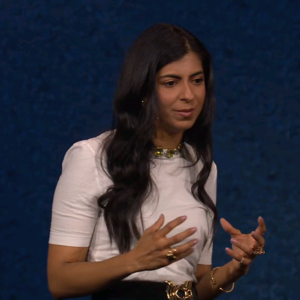
Nayeema Raza | TED • Nov 2025
I ask questions for a living to people like Mark Cuban, Neil deGrasse Tyson, Esther Perel, Bill Nye. These masters of their field. And the most surprising answer I heard this year was from two 11-year-olds named Sophie and Dilan. They too are experts in being kids these days. So I asked them, how does time with people on screens feel different than real life?
(Video) Sophie: It just makes you feel more with them when you're on FaceTime.
Nayeema Raza: Even more than real life?
Sophie: Yeah, because you're doing stuff together. Like maybe playing Roblox together. Because nowadays, when you're with them, everyone's on their phones.
NR: Sophie's pointing out a profound paradox. When we are together physically, we are each alone on our phones. But when we're in our phones, that's when we can be together. The best way to not be distracted by your device? Just get inside of it.
Now these 11-year-olds are not talking about some distant, anxious generation. They're talking about each of us. They're definitely talking about me and about a world that's increasingly driven by machines.
So I stumbled upon an extreme metaphor for what this could look like. And it's this guy who's locked in a Waymo, and it's driving him in circles. So he calls customer service and finds out he's not the only one trapped.
(Video) Woman: Working with the situation of the vehicle.
If you have your app pulled up, I need you to tap My Trip on the lower left corner of your app.
Man: Can't you just do it? You should be able to handle it. Take over the car. You don't need my phone.
Woman: I don't have an option.
NR: It is sexy to think that the tech apocalypse is Arnold Schwarzenegger and "The Terminator," but it could be so much more mundane than that. Just us driven in circles, held hostage by drop-down menus, with gadgets, disintermediating us from each other, from our own bodies and from our curiosities.
Because nowadays, when we have a question, we don't wait and phone a friend. We friend our phones. And that feels so empowering to have all of this knowledge at our fingertips. Yet early research from MIT tells us it's making us lazier and less smart, and it is definitely making us less connected. This is not what our parents and grandparents were sold when they saw this relic of an ad from AT&T which says, "Reach out and touch someone." And yes, for all kinds of reasons, it would not go down well today.
But it is oddly prescient because we have never been more connected and more out of touch.
Now I'm not anti-tech. I actually cover it as a journalist. I have every gadget under the sun, and most days I think I'm in a relationship with my ChatGPT, or as I like to call him, Chat Daddy.
I am pro-human. And as we progress into an AI world that you've read 471.5 articles about today alone, I want to make a case for old habits. Three of them. And tell you how I learned them the hard way.
The first is to pause, to take just one second when you feel that urge to reach for your digital pacifier. This, by the way, is a second. Studies show waiting that long before taking action lets your brain work better.
The second is to wonder. Watch a movie without googling who the actor is and what else is he in, and how old he is, and is he single? You can float in your own curiosity instead of drown in information.
And the third is to ask a question out loud again. Have that fight at a dinner party instead of playing footsie with your phone. Ask something to someone you thought you couldn't learn from, or someone you think you know everything about. Because the dumbest thing we can be is know-it-alls.
A few years ago, my father passed. In the days leading up to it, I was glued to devices. They had all these answers. The number to his hospice nurse, how often to give them morphine, the signs to look out for, his heartbeat. But when he passed on a Sunday, a day before the data and the vitals suggested he would, that's when it hit me. The old habits were what mattered. Those seconds of pause that added up to minutes more. That weird and scary wonder about our own finite lives. And the little questions people ask me, like, "How can I be there for you?"
Sophie was on to something, but we're grown ups, and we remember when presence and curiosity and connection were possible outside of technology. We have to practice these old habits if we hope to pass them on to a new generation. If we want to teach them how to be together when we are together. Right, Chat Daddy? Thank you.
🗣️更多文本和视频见公众号【琐简英语】,回复1可加入【打卡交流群】
TED|3 habits to practice curiosity — and escape your phone
5分钟 · 364·
364· 0
0
3640