

 22
22 0
0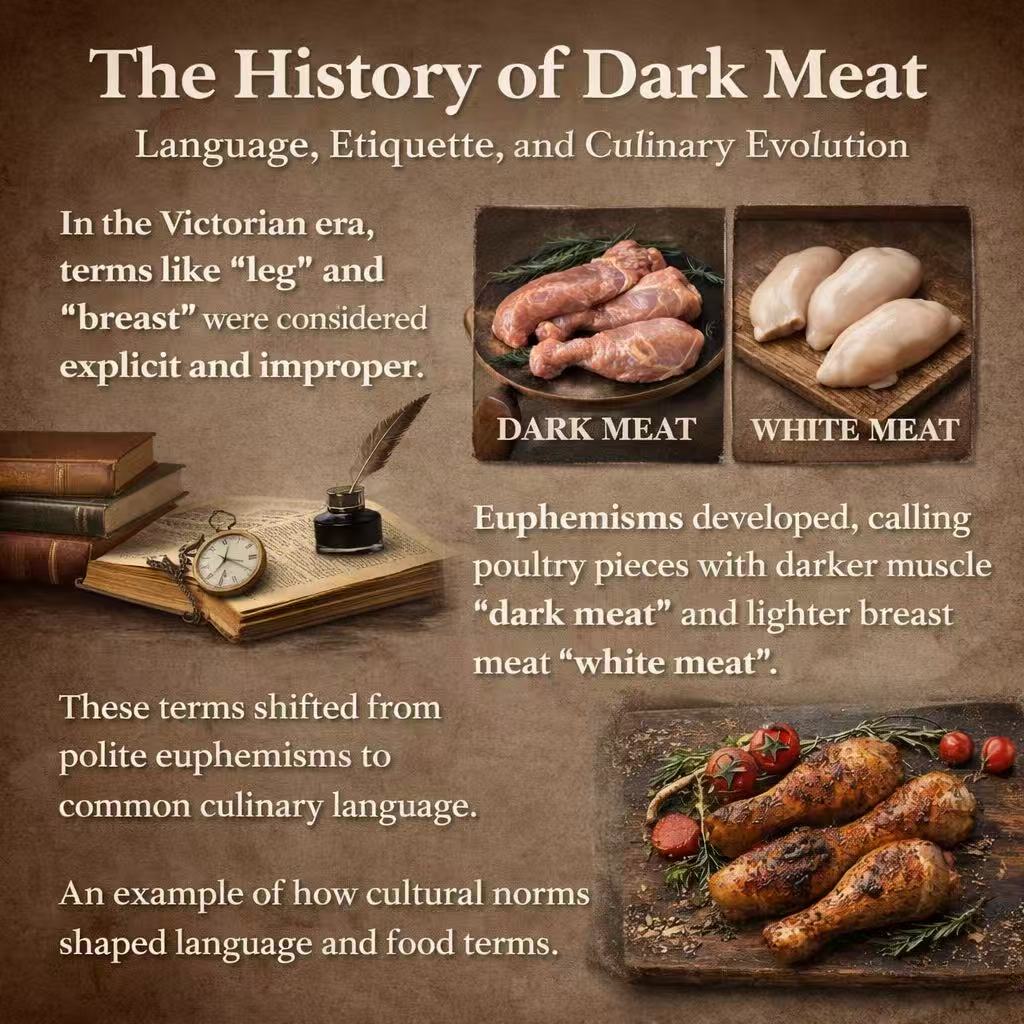
The term “dark meat” has an interesting origin rooted in both language history and cultural sensitivity. In medieval and early modern England, especially during the Victorian era, people often avoided directly naming certain body parts in polite conversation. Words like leg and breast were considered too explicit or even improper in refined society. As a result, euphemisms developed.
When referring to poultry at the dining table, instead of saying leg or breast, people began to use more indirect and socially acceptable terms. The meat from the legs and thighs of animals, which appears darker due to higher levels of myoglobin (a protein that stores oxygen in muscles), came to be called “dark meat.” In contrast, the lighter-colored breast meat was labeled “white meat.”
Over time, these terms lost their original function as euphemisms and became standard culinary vocabulary. Today, “dark meat” is no longer about politeness but about texture, flavor, and nutritional differences. Dark meat is generally juicier and richer in taste, reflecting the more active muscles of the animal.
This linguistic shift shows how social norms can shape language, and how words that begin as indirect expressions can eventually become neutral, technical terms in everyday use.
“dark meat(深色肉)”这个词的来源,既与语言历史有关,也反映了特定的文化背景。
在中世纪以及近代早期的英国,尤其是维多利亚时期,人们在正式场合往往避免直接提及某些身体部位。像 leg(腿) 和 breast(胸) 这样的词,在当时被认为过于直白,甚至有些不雅。因此,人们开始使用委婉语来替代这些表达。
在餐桌上谈论禽类时,人们不再直接说 leg 或 breast,而是采用更含蓄、更礼貌的说法。由于动物的腿部和大腿肌肉中含有较多的肌红蛋白(myoglobin,一种储存氧气的蛋白质),这些部位的肉颜色较深,于是就被称为 “dark meat(深色肉)”;相对地,颜色较浅的胸肉则被称为 “white meat(白肉)”。
随着时间的推移,这些表达逐渐失去了原本作为委婉语的功能,转而成为标准的烹饪术语。如今,“dark meat”不再与礼貌或避讳有关,而更多用于描述肉的质地、风味和营养差异。深色肉通常更加多汁、味道更浓郁,这也与这些部位肌肉活动更多有关。
这一词汇的演变表明,社会习俗会深刻影响语言的发展,而原本出于含蓄表达而产生的词语,最终也可能演变为日常中性甚至专业化的术语。
original / əˈrɪdʒənl / adj. 原来的;最初的;独创的
用法:original idea / original plan / the original meaning
例句:This is the original version of the story.
这是这个故事的最初版本。
consider / kənˈsɪdə(r) / v. 考虑;认为
用法:consider doing / consider sb. (to be) / take sth. into consideration
例句:You should consider taking more exercise.
你应该考虑多锻炼。
improper / ɪmˈprɒpə(r) / adj. 不合适的;不礼貌的
用法:improper behavior / improper use
例句:It is improper to speak loudly in public.
在公共场合大声说话是不合适的。
explicit / ɪkˈsplɪsɪt / adj. 明确的;直白的(常指不加掩饰)
用法:explicit explanation / explicit content
例句:The teacher gave explicit instructions.
老师给出了明确的指示。
euphemism / ˈjuːfəmɪzəm / n. 委婉语(用温和表达代替直接说法)
用法:use a euphemism for / common euphemisms
例句:“Pass away” is a euphemism for “die.”
“去世”是“死亡”的一种委婉说法。
myoglobin / ˌmaɪəˈɡləʊbɪn / n. 肌红蛋白(存在于肌肉中,影响肉的颜色)
用法:levels of myoglobin / contain myoglobin
例句:Dark meat contains more myoglobin than white meat.
深色肉比白肉含有更多的肌红蛋白。
