
 25
25 0
0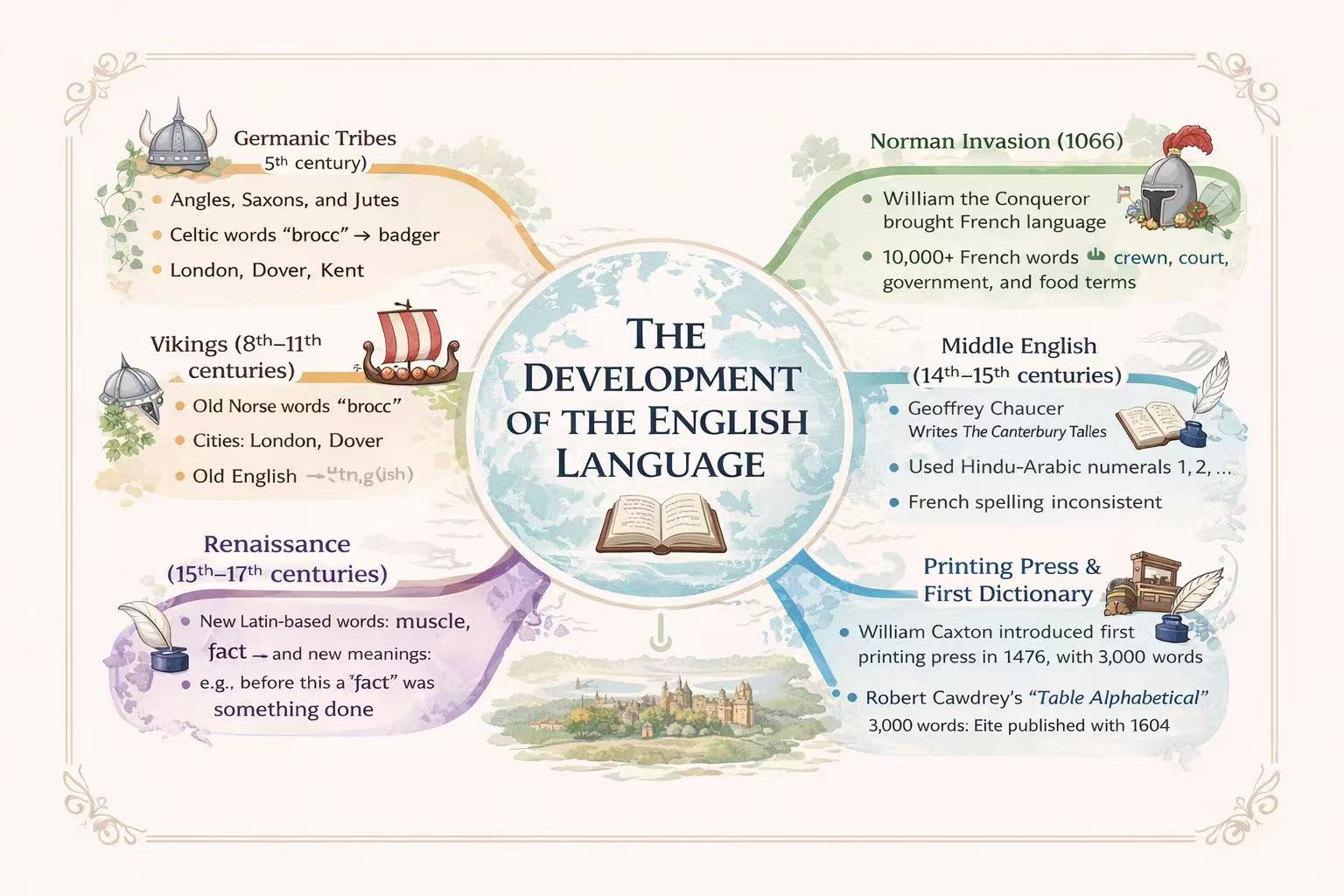
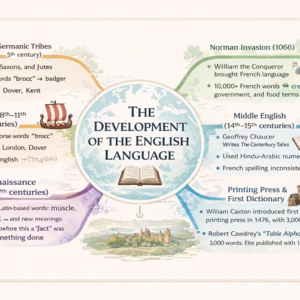
English didn’t just appear overnight—it’s the result of centuries of mixing, borrowing, and reshaping.
It all started in the 5th century, when Germanic tribes like the Angles, Saxons, and Jutes invaded Britain. They brought their own dialects, which eventually became Old English. The original Celtic languages didn’t disappear completely, but they left only a small mark, mainly in place names.
Then came the Vikings. They spoke Old Norse and added everyday words like sky, skill, and skin, as well as pronouns like they and them. Their influence wasn’t massive in quantity, but it definitely shaped how English sounds and works.
The real game-changer happened in 1066, when the Normans invaded. French became the language of power—government, law, and the upper class. That’s why English today has pairs like cow (animal) and beef (food). English basically became a mix of Germanic roots and French vocabulary.
By the time of Chaucer, English was finally being used in serious writing. Then the printing press came along in the 15th century, helping to spread and standardize the language, even though spelling was still all over the place.
During the Renaissance, English exploded with new words, many borrowed from Latin. Meanings also shifted—for example, fact went from “something done” to “something true.”
So modern English is really a patchwork language—built layer by layer, shaped by history, invasion, and culture.
英语并不是一夜之间出现的,它是经过几个世纪不断融合、借用和演变形成的。
一切始于5世纪,当时盎格鲁人、撒克逊人和朱特人等日耳曼部落入侵不列颠。他们带来了自己的方言,这些方言逐渐发展成为古英语。原本的凯尔特语言并没有完全消失,但只留下了很小的影响,主要体现在地名上。
接着是维京人的到来。他们使用古诺斯语,为英语带来了像 sky(天空)、skill(技能)、skin(皮肤)这样的日常词汇,以及 they、them 这样的代词。虽然他们带来的词汇数量不算多,但对英语的发音和结构产生了重要影响。
真正的转折点出现在1066年诺曼征服时期。法语成为统治阶级、政府和法律领域的语言。这就是为什么英语中会出现像 cow(动物)和 beef(食物)这样的词汇对。英语逐渐变成了一个融合了日耳曼词根和法语词汇的语言。
到了乔叟时代,英语终于被用于严肃的文学创作。随后,15世纪印刷术的引入推动了语言的传播和标准化,尽管当时的拼写仍然非常混乱。
在文艺复兴时期,英语词汇迅速扩展,大量词汇来自拉丁语。同时,一些词义也发生了变化,例如 fact 从“做过的事情”变成了“真实的事情”。
因此,现代英语其实是一种“拼接式”的语言,是在历史、入侵和文化影响下,一层一层发展形成的。
1. appear /əˈpɪə(r)/(中考)
① 出现;显现
• A star appeared in the sky.
天空中出现了一颗星星。
② 似乎;看起来
• She appears to be tired.
她似乎很累。
🔹搭配:appear suddenly / appear to do
⸻
2. influence /ˈɪnfluəns/(中考)
① n. 影响
• His teacher had a great influence on him.
他的老师对他影响很大。
② v. 影响
• Music can influence people’s mood.
音乐可以影响人的情绪。
🔹搭配:have an influence on / be influenced by
⸻
3. dialect /ˈdaɪəlekt/(高考)
n. 方言(某一地区的语言变体)
• People in this village speak a local dialect.
这个村子的人讲地方方言。
🔹考点:区别 language(语言) vs dialect(方言)
⸻
4. pronoun /ˈprəʊnaʊn/(高考)
n. 代词(代替名词的词)
• “He” and “they” are pronouns.
he 和 they 是代词。
🔹分类:personal pronouns(人称代词)
⸻
5. Renaissance /rɪˈneɪsəns/(高考)
n. 文艺复兴(欧洲文化复兴时期)
• Many new ideas appeared during the Renaissance.
文艺复兴时期出现了许多新思想。
🔹引申:a renaissance of…(……的复兴)
⸻
6. patchwork /ˈpætʃwɜːk/(高考)
① n. 拼布;拼接物
② 比喻:混合体(重点)
• English is a patchwork of many languages.
英语是多种语言的混合体。
🔹高级表达:a patchwork of cultures / ideas
⸻
