


 8108
8108 11
11在练习英语听力时,我们可能有这样一种感觉,就是我练的越多,听力就越好,但是其实并不是这样哦。听力练习一定要有一个前提,就是听得对,听得准。
如果我们盲目的多听,可能只会在错误的道路上越滑越远。但是,听得准可不容易,就算是英语母语者,也有可能是听错的。
本期节目将带大家识别听力中的“脑补现象”,介绍如何练习听力才能避免在错误练习的道路上越走越远。

时间轴
00:00 多听多练的前提:听得准
01:34 母语者也会听错:Just for all(为了所有人)听成Justice frog(正义蛙
03:33 母语者与非母语者误听的区别:语义层面 vs 语音层面
非母语者的修复(Repair)过程:脑补不存在的音,将其靠拢向熟悉的语音
05:08 为什么我们会把 Please 听成 Police?
07:40 如何有效提升听力:培养音节意
英文部分大纲
I. Introduction: Setting the Stage
- "Misharing" sounds: funny but frustrating listening errors.
- Passive listening (被动听力) isn't enough.
- Focus: Unique listening challenges for Mandarin speakers (普通话母语者).
- Goal: Explain sound confusions & improve listening skills (听力技能).
II. How We Hear: Your Native Language Filter (母语过滤器)
- Listening is an active process (主动过程).
- Your brain uses Mandarin knowledge to interpret English sounds.
- This "filter" can cause misinterpretation (误解) of unfamiliar English sounds.
- You might not initially notice certain sound distinctions (发音区别).
III. Common Sound Traps (常见发音陷阱) for Mandarin Speakers
- Vowel Sounds (元音):English has more vowels than Mandarin.
Vowel length (元音长度) matters in English (e.g., sit/seat).
Confusing pairs:/ɪ/ vs /iː/ (sit/seat) - length.
/æ/ (bat) vs /ɛ/ (bet) - tough distinction.
/ʌ/ (cup) vs /ɑː/ (carp) - /ʌ/ often misheard.
/ʊ/ (full) vs /uː/ (fool) - can cause misunderstanding.
Schwa sound /ə/ (弱读元音): (e.g., about) Hard to notice, often lost.
Diphthongs (双元音): (e.g., now, go) Can be simplified. - Consonant Sounds (辅音):Some English sounds are new (e.g., "th" /θ/, /ð/; /v/ sound). Often replaced with /s/, /z/, or /w/.
/l/ & /r/: Different use at syllable ends (e.g., hill, car).
Final Consonants (尾辅音): Big hurdle! English has many more than Mandarin.May not be heard (e.g., "wor" for "words").
Extra vowel added (e.g., "fit-uh" for "fit").
/n/ vs /ŋ/ (e.g., sin/sing): Still a challenge. - Consonant Clusters (辅音丛):Complex in English (e.g., strengths), unlike Mandarin's simpler syllables.
Brain copes by:Epenthesis (增音): Adding a vowel (e.g., "sa-poon" for "spoon").
Deletion (吞音/省音): Dropping consonants (e.g., "wors" for "words"). - Connected Speech (语流音变):English words flow; Mandarin syllables often more distinct.
Features like elision (省音) & assimilation (同化) add complexity. - Suprasegmentals (超音段特征): Stress (重音), Rhythm (节奏), Intonation (语调)Fundamental difference: Mandarin is tonal (声调语言); English is stress-timed (重音计时语言).
Mandarin ears tuned for pitch (音高) for word meaning, making English stress hard to grasp.
Affects rhythm & interpreting intonation for grammar/attitude. - Illusory Vowels (幻觉元音):"Hearing" extra vowels in clusters (e.g., "eschool" for "school"). Brain fits sounds to Mandarin rules.
IV. Why These Misperceptions? The Root Causes (根本原因)
- L1 Interference from Mandarin (母语干扰): Main culprit!Phonological Filtering (语音过滤): English heard through Mandarin sound system.
Different Sound Inventories (音位库差异): Missing sounds replaced; fewer vowel distinctions.
Syllable Structure Rules (音节结构规则) (Phonotactics): English manipulated to fit Mandarin patterns.
Influence of Tones (声调影响): Interferes with perceiving English stress/intonation. - English Phonology: Silent letters, irregular spelling.
- Cognitive Factors: Processing load (处理负荷) increased by L1 interference.
V. Strategies for Improvement (改进策略)
- Awareness (意识) is the first step.
- Effective Strategies:Explicit phonetic instruction (语音教学).
Minimal pairs (最小对立体) practice (e.g., ship/sheep).
Using IPA (国际音标).
Practice consonant clusters, connected speech (e.g., shadowing 跟读).
Focus on English stress, rhythm, intonation.
VI. Conclusion: You Can Conquer English Sounds! (结论)
- Mandarin speakers face real listening challenges due to sound system differences.
- Understanding misperception patterns & reasons is key.
- Knowing pitfalls helps strategic learning.
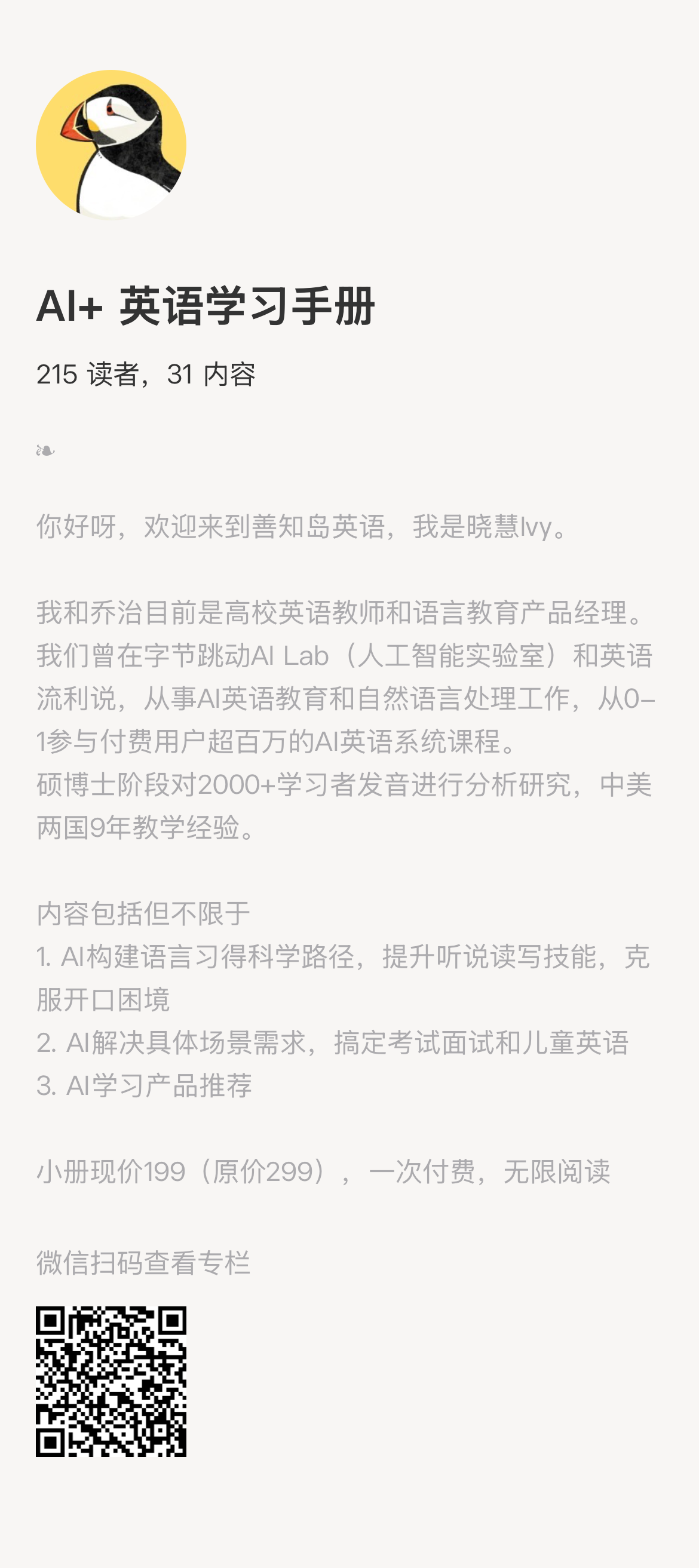
我们在微信的小报童平台上上专门写了一个专栏《AI+ 英语学习手册》,详细介绍了如何利用 AI 诊断发音问题、进行跟读模仿和对话练习,欢迎感兴趣的小伙伴订阅!
欢迎大家留言分享你的感想,或者加晓慧Ivy同学的微信加入我们的听友群参与讨论~